

Unknown's avatar

About Jaclyn

Reader, writer, bookaholic for life!

Review | The Far Side of the Sky, Daniel Kalla

Kristallnacht. Crystal Night. Such a beautiful name for such a horrific event. Daniel Kalla’s The Far Side of the Sky begins right in the middle of this Nazi attack on Jews in Austria, and the pace never lets up. Surgeon Franz Adler is a secular Austrian Jew who just wants to stay under the radar. Unfortunately, as the “incriminating large red J” stamped on his passport proves, his very ancestry already puts him in the Nazi crosshairs, no matter what he does or doesn’t do.

So Franz takes his family (daughter Hannah and sister-in-law Esther) to Shanghai, a major refugee base for European Jews because visas aren’t required to enter. Thing is, Shanghai at that time was occupied by Japan, so it really wasn’t so much of an escape as it was a movement to a different atmosphere of fear. In Shanghai, Franz meets a Chinese-American nurse, Soon Yi “Sunny” Mah, who works with him at the Jewish refugee hospital and who is prevented from becoming a doctor only by her gender. Far Side is about people who want only to live a simple life, and yet are prevented from doing so by circumstances and their heritage. It’s tragic, yet made somewhat more bearable by their relationships with people around them.

A lot of books have been written about World War II and the years before and after it, yet most of the ones I’ve seen are about either the West or the East. Far Side stands out to me because it shows how Europe and Asia connected during this period, and how the situation in Asia was just as horrific as the one in Europe.

I love that Franz isn’t really a hero — all he wants to do is to live as normal a life as possible — and yet circumstances force him to do heroic things. I also love that both Franz and Sunny have complex backgrounds — Sunny, for example, is Chinese-American, so she faces discrimination both from the Japanese soldiers who look down on the Chinese and the Chinese who look down on those who aren’t full-blooded Chinese. In Franz’s case, his being a non-practicing Jew makes his troubles with the Nazis even more tragic; he is ostracized for a belief system to which he doesn’t even subscribe and for a race he has himself rejected.

The supporting characters are just as fascinating. The American Simon Lehrer, for example, is delightful, almost relentlessly cheerful and a welcome respite from the darkness of the material. Ernst Muhler, who wages war through his art, is a charismatic, engaging figure. Ernst is the most defiant, political figure in Franz’s community, and his fear at the realization of what he might have to sacrifice on a personal level makes him an absolutely sympathetic character. Like the victims whose unjust deaths he depicts in his art, I cheer Ernst on in his crusade; yet like Franz and other friends in Ernst’s life, I also want him to stop, and perhaps find some measure of happiness and peace.

In war, it’s far too easy to see different factions as either all good or all evil. So I love how Kalla portrays Hermann Schwartzmann and Colonel Kubota. A senior attache with the German High Commission, Hermann has no ill will towards Jews and even tries to befriend Franz. He chooses to compartmentalize, to not speak out against the Nazis so that he and his wife can have a stable life. I can understand why Franz finds Hermann’s silent complicity cowardly, even reprehensible, yet I can’t help but feel sorry for Hermann. Like Franz, Hermann also just wants to live as normal a life as possible; only difference is, Hermann is better placed to benefit from compliance. With Hermann, Kalla presents the other side of the story, the moral difficulties faced by non-Jew Germans and Austrians.

Colonel Kubota, head of the Japanese contingent in Shanghai, acts with honour and compassion. Kubota’s admiration of Ernst’s work and Ernst’s refusal to have Kubota own his art provides a kind of tension that I love. Kubota and Ernst are figures from opposite sides of two different wars, and their desire to connect or repel through art is just beautifully portrayed.

One thing I really did not like happened near the end, where Sunny does something that has a dramatic impact on a historical figure’s actions. In a novel that focuses on the struggle to live an ordinary life, that explores mundane human relationships to evince emotion, Sunny’s dramatic act rings false. It made me question, “Since this is based on history, and this character doesn’t exist in real life, then what really happened?” That part disconnected me from the story, which is a shame because of the major emotional impact already created by all the smaller scale heroic actions in the story.

Also, we are told several times that Franz’s daughter, Hannah, is handicapped. This is significant because Franz worries about how she’ll survive if he is killed or arrested. However, I see no symptoms from descriptions of Hannah herself and her actions, and so have to keep turning back to be reminded of the cerebral palsy that has other characters so worried. A small detail that shows Hannah’s “spastic weakness of left arm and leg” would have helped me picture her and better understand why Franz is especially concerned about how she would adjust in a foreign country.

Overall, Far Side is a wonderful, emotional book. Highly recommended for fans of historical fiction, romance, and David Mitchell’s Thousand Autumns of Jacob de Zoet.
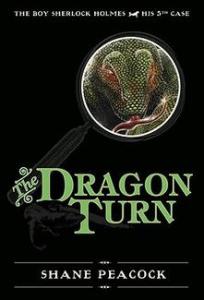
Review | The Dragon Turn, Shane Peacock

The Dragon Turn is the fifth book in Shane Peacock’s Boy Sherlock Holmes series, and the first one I’ve read. I’m a huge Sherlock Holmes fan, so reading a book about a teenage version of him will either be an absolute delight or an absolute disaster, depending on how Peacock chooses to portray him. I was also worried I might’ve outgrown YA adaptations of older characters. For example, I used to devour The Nancy Drew Notebooks, the Starfleet Academy series, even the Young Jedi Knights series. Now, while I still like YA, I’ve felt no desire to go back to those books.

I really liked Dragon Turn. Its mystery is more mystical (it involves a dragon) than I expected a Sherlock Holmes story to be, but, like all Holmes stories, presents a logical solution. A magician called the Wizard of Nottingham is killed. All that’s left of him are his blood and spectacles in the office of his professional and romantic rival Hemsworth. The climax of Hemsworth’s act involves a dragon, which offers a possible, gruesome explanation to the disappearance of the Wizard’s corpse.

Peacock’s Sherlock is a highly intelligent, logical fifteen year old, who already has plans of becoming a detective when he gets older but who, in the meantime, just wants to keep a low profile. He’s half-Jewish, and so faces discrimination, which may explain part of his desire to remain below the radar. So, rather than take credit for mystery solving, Sherlock feeds information to Lestrade, a young police officer intent on impressing his Inspector father. I love this characterization of Sherlock and young Lestrade. The adult Holmes is such a confident, almost arrogant man, and I love seeing this younger version of him as more vulnerable, insecure and self-conscious. He’s sympathetic in a much different way from the adult Holmes, yet he maintains the intelligence and logic that so characterize Holmes as a detective.

I also enjoyed seeing Lestrade as a young man longing for approval. I was expecting either a bumbling, incompetent Lestrade or an absolute bully, so I was pleasantly surprised to see him so sympathetic. He’s still incompetent as a detective, but his desire to impress his father casts a whole new light on his approach towards detecting.

Peacock even gives Sherlock a love life, which I don’t usually enjoy in mysteries, but which I liked here. Romance also prompts a reluctant Sherlock to get involved in the Wizard’s case. Sherlock’s girlfriend Irene Doyle (who, I presume, will grow up to marry a Mr. Adler and later become The Woman in Holmes’ life) was promised a boost in her stage career by Hemsworth, so she convinces Sherlock to help prove Hemsworth’s innocence. It’s a complicated case, and soon even Sherlock isn’t sure about what really happened to the Wizard. I did figure out the answer before the big reveal, but then the book is aimed at readers much younger than I am (never mind how much younger), so that’s really nothing to brag about. (I’m still bragging, though. I almost never guess the answer before the big reveal!) Still, Peacock pieces together the puzzle well, and I loved seeing Sherlock before he became the infallible detective we all know.

Dragon Turn is a wonderful book. I think its target audience (ages 10 – 14) will love it for its adventure, mystery and characters, and, as an older reader, I enjoyed it for the way Peacock wrote Sherlock Holmes. On a minor note, I much prefer Beatrice Leckie to the more worldly and manipulative Irene Doyle. As far as I know, Beatrice is a wholly Peacock-created character, and she’s just a lovely Betty Cooper-type character, and I’m crossing my fingers that Sherlock will eventually end up with her, if only in Boy Sherlock Holmes.

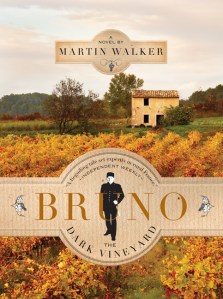
Review | Dark Vineyard, Martin Walker

I love Martin Walker’s Bruno, Chief of Police series. Captain Bruno Courreges is a combination of Guido Brunetti and Tom Barnaby, and he solves mysteries in the small town of Saint-Denis in France. He never carries his official gun and has “long since lost the keys to his handcuffs.” He’s a gourmet chef and gentleman detective, and really, how can you resist such a lush, beautiful setting?

So I was thrilled when Harper Collins Canada finally released the Harper Weekend paperback of Dark Vineyard, the second in the Bruno series. A beautiful little edition that can fit in my purse, it’s the perfect companion to my lunch break, preferably spent lounging on a park bench on a beautiful day. Lush, beautiful and romantic are rarely words I use to describe mysteries, but in this case, St. Denis is so utterly tangible that the words just fit.

In Dark Vineyard, American wine mogul Fernando Bondino has come to St Denis to buy up the local vineyards to use for his company’s production. Bruno fears this means the end of the way of life he loves in St Denis. Then people start getting killed. It’s an even more complex mystery than the one in Bruno, Chief of Police, and Dark Vineyard is more tightly plotted, with a more logical string of clues to the big reveal.

Dark Vineyard is also filled with charming characters, from talented young winemaker Max to flirtatious Quebecois Jacqueline. The mystery features arson, a love triangle and a corpse in a vat of wine. It’s a puzzling whodunnit, and, because of the characters and the setting, an absolute delight to read.

What really makes Dark Vineyard such a wonderful book, however, and this is probably true of the Brunetti and Barnaby books as well, is the detective himself. It’s natural to root for the underdog, and Bruno’s town feels like the ultimate underdog of locations, a small-time indie in a world of Walmarts. The Bruno stories provide a wonderful escape, contemporary tales in a town apparently untouched by modernity. And Bruno, by clinging on so tightly to that way of living, is a champion of the underdog, a man of peace in a crusade against those that threaten this leisurely way of life. Sitting on a park bench surrounded by tall, grey office buildings, it’s lovely to imagine living in Bruno’s world, and it’s natural to cheer him on as he struggles to protect it.

In Dark Vineyard, this struggle becomes even more pronounced, because of Fernando’s plans to buy out the town and change its very character. Bruno’s girlfriend lives and works in Paris, and wants him to join her there; after all, he has a standing job offer from the Paris police force. Yet moving away from St Denis will mean giving up a lot of who Bruno is. His struggle to keep his town is touching, especially because his personal feelings may conflict with his professional desire to solve the recent crimes.

Bruno is a man to admire, and his town is a place I want to visit. In an early scene, Bruno walks off in the middle of a haircut to investigate an argument at a nearby wine shop. A customer had broken a bottle of wine and was refusing to pay for it.

Knowing the way to the shelf of Petrus, Bruno led his small entourage to the altar of this temple to wine, and stopped, looking mournfully at the smashed bottle on the tiled floor. Out of respect, he removed his hat…

Here is a detective who mourns the death of a bottle of good wine, who considers a day in the market as “a gathering of friends,” and who genuinely cares about his town and the people in it. Walker’s description of Bruno cooking a truffle omelette (his specialty!) for a dinner party is as mouth-watering as any of Paola Brunetti’s meals, and St Denis is even more lush and beautiful than Tom Barnaby’s Midsomer villages.

Fans of Donna Leon, Caroline Graham, Agatha Christie, foodie mysteries or cozy mysteries — you’ll love Bruno Courreges. The third book in the series, Black Diamond, is already available in hardcover, and the mystery revolves around truffles rather than wine. As a total foodie, I love the subjects of Walker’s mysteries, and I can’t wait till Black Diamond comes out in the lovely Harper Weekend edition next year!