
Unknown's avatar

About Jaclyn

Reader, writer, bookaholic for life!

Review | Ragnarok, A.S. Byatt

I should have loved Ragnarok. It’s well-written and tells the fascinating story about the end of the gods. It’s also fraught with symbolism, conflating the Norse myth of Ragnarok with the tale of an unnamed “thin child in wartime,” who somehow feels a connection to the Norse gods. Byatt draws on fascinating material, and there are a lot of elements that I did like, but overall, I felt detached. I found some beautiful passages to highlight, but I rarely felt compelled to turn the page and keep reading.

As I’ve said, I do like a lot of things in the book. I like the child’s reflection on stories and on “the meaning of belief.” She contrasts the Christian myth in Bunyan’s Pilgrim’s Progress and the Norse myth in Asgard and the Gods — both are myths, yet Asgard is more preferable because it fires the imagination instead of being didactic. Entering a church, the child “took up the burden of being required to believe what she could not believe — and, she knew, […] did not want to believe.” The imposition of belief on Christian stories turns them sour for the child, and I like how she chooses to wage her rebellion against society within the realm of stories. Living in wartime, being exposed to pain and death as a way of life, the child pursues freedom in the stories she chooses to read, and as an avid book lover myself, this is a mode of battle I highly endorse.

I also like that the child prefers Norse myths because they have no “clear message and meaning,” but rather talk about a “mystery, of how a world came together, was filled with magical and powerful beings, and then came to an end. A real End. The end.” I can see the appeal of such a story to a child dealing with the senselessness of war, the thought that the world did once make sense, but no longer did and the idea of an end, full stop. The idea of “a real End,” while it applied to the gods, also holds the hope of a “real End” to the war, sometime.

So there’s a sense of wistfulness, even a tinge of desperation in her protectiveness towards the Norse myths. She dislikes the Norse story of the giant Bergelmir building a boat to survive a deluge because it’s too much like the Christian tale of Noah’s Ark: “She wanted to keep this tale separate.” Pure, in a way, from the absolutes she sees in Christianity. Yet there’s always that hint of inevitability — just as the Norse gods are destined to die, so can you sense this child’s ability to live in the world of myths is also destined to end.

Still Ragnarok didn’t really grab me. I like the narrative tone, which sounded like a story teller relating an old story handed down for generations (just like a myth!). I also enjoyed some of the stories from Norse mythology, especially the part after Loki sets off the series of events that lead to the end of the gods. But I think that style also kept me from becoming too engrossed in the story. The reading experience just felt too impersonal to me, and I felt like I was reading a collection of Norse myths for research. The frame narrative of the thin child in wartime has some beautiful insights, yet the detached perspective prevented it from really propelling the bits of researched Norse myths forward.

I read Byatt’s essay “Thoughts on Myths” at the end of the book and found it fascinating. I love the comment that “Every culture that has lost myth has lost […] its natural healthy creativity. Only a horizon ringed about with myths can unify a culture.” Absolutely. Byatt also observes that we “think less and less in terms of raw myth” and other writers have “assimilated myths into the form of novels.” Presumably then, Byatt has chosen to keep Ragnarok as close to “raw myth” as possible, and in that I think she succeeded. I might have preferred a more novelistic approach, which is perhaps why I enjoyed most the section about Loki and Ragnarok in the end, where the action picked up.
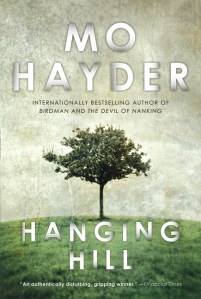
Review | Hanging Hill, Mo Hayder

The only other Mo Hayder book I’ve read was Pig Island, and it really creeped me out. I also found it gross, though I can’t remember exactly why (and to be honest, I don’t want to remember either). So I approached Hanging Hill with interest, but also a bit of trepidation.

There was a mystery in Hanging Hill — a teenaged girl was murdered — but the story really revolved around the lives of two sisters: Zoe, one of the detectives investigating the murder, and Sally, a divorcee whose daughter is the victim’s classmate.

From my experience with Pig Island, I was expecting a horrifying tale. Instead I got a very touching one, horrifying not in the gross, almost supernaturally creepy way of Pig Island, but in a much more basic, emotional way of seeing the lives of characters you care for turn out horribly. I felt bad for Sally, who was doing her best to take care of her daughter Millie. All Millie wants is to fit in with her wealthier classmates, and this leads to her making some bad decisions, which in turn forces Sally to take a job as housekeeper for a man with shady connections. It’s a difficult situation, and at times it felt like a horror movie, where you know Sally’s decisions will only lead to more trouble, and yet feel as helpless as she does in finding another way out.

Zoe is almost as sympathetic a character — strong-willed and hot-tempered, she sometimes came off as too defensive and jealous of the beautiful psychological profiler. She gets very involved in her cases, and Hayder shows how Zoe almost literally tries to identify with the victims. For example, the victim in this case was gagged with a tennis ball, so Zoe puts a tennis ball in her own mouth and forces herself to keep it in for as long as she can, to imagine how the victim must have felt in her final moments. Zoe also has some skeletons in her closet, and when the skeletons in her past somehow connect with the problems of Sally’s present, the momentum picks up and you can just see both sisters’ lives going out of control. The siblings are estranged, because of an incident in their childhood, and at times, I just wanted to yell at them to make up and get back together already, because it would help solve both their problems.

I especially love the Millie storyline. On one hand, I was annoyed by her for getting into such deep financial trouble just so she can join a school trip. On the other hand, I can only begin to imagine what a terrifying situation she was in, especially for a teenager, and I was more annoyed at the father (Sally’s ex) for not bailing her and Sally out. I loved the storyline of Millie being in love with the hot guy (who of course was in love with someone else), when Millie actually had a nerdy friend already in love with her. Sally promised the nerdy friend that someday, when Millie grew up, she’d see him in a new light. I thought that was sweet.

The mystery itself was pretty difficult to solve, and the ending took me completely by surprise. I thought the final scene was a particularly gutsy way to end the book. I actually checked if there were additional pages I’d missed — surely Hayder wouldn’t end it with that! — then, finding none, thought, “Good for you, Mo Hayder.” Hanging Hill takes a while to build up — it focuses so much more on character development than mystery solving — but once it gets going, the momentum just keeps building, and it ends with a bang.

Review | The Decision, Penny Vincenzi

What a treat it is to read a Penny Vincenzi novel! The blurb from Daily Express likens The Decision to a “glass of Champagne: bubbly, moreish and you don’t want it to end.” I’ve never read Vincenzi before, but I was in the mood for a Champagne-type novel. True enough, The Decision was like a bubble bath of a book — luxurious, frothy and oh so indulgent.

To be clear, the book tackled a lot of very serious issues as well, particularly women’s rights and the role of a mother. It had its emotional moments, and at times, I was literally outraged at how Matt (the hero) treated Eliza (the protagonist). However, all these were framed within the story of a delightful Mad Men world of fashion, travel and romance. Escapist fiction with big ideas — love it!

To tell you more about The Decision, here’s a video I found on Vincenzi’s website, where Vincenzi herself tells us about the book and reads some excerpts:

Penny Vincenzi – The Decision from BeyondTheBlurb on Vimeo.

(source: http://www.pennyvincenzi.com/thedecision.html)

From the prologue and the back cover, we already know what’s going to happen to Matt and Eliza’s relationship — it won’t work out, and they’ll have a messy custody battle over their daughter Emmie. To my surprise, Matt and Eliza get married almost halfway through my 758-page ARC. Forget any concern about spoilers — the custody battle alluded to in the prologue only about 3/4 through the book, so you’re reading hundreds of pages about Matt and Eliza’s romance, with the full knowledge that it won’t last.

To my even greater surprise, it didn’t matter at all that I knew how it was going to turn out — I still had a great time watching it unfold. A lot of that is because of the world Vincenzi created, filled with fascinating characters you can’t help but root for. Take Eliza, for example. Raised in a wealthy family that just wants her to marry rich and have babies, Eliza prefers to be a successful career woman in the fashion industry. She has a natural instinct for fashion, and I loved watching her organize fashion shoots and come up with ideas for magazine features. It’s a glamourous world, and Vincenzi’s writing just wraps us up in it.

I especially love that despite her ambition, Eliza agrees to give up her career to raise a family with Matt. I didn’t agree with her decision, and in fact Eliza’s reluctance to do so was very evident. However, I love the complexity it added to her character. She wasn’t even a starry-eyed Bella Swan type; rather, she was a mature yet vulnerable young woman, like Julia Stiles’ character in Mona Lisa Smile, who wanted to make her marriage work. I didn’t agree with her decision, and given how unhappy it made her, I couldn’t really respect it, but I did sympathize with it, and with her. I especially, especially love that, even after having made the decision to give up her career, Eliza clearly struggles with it every day. I can imagine how many women in the 60s did face that dilemma, and I love how textured and complex Eliza’s character was.

Then there’s Matt. Ambitious, handsome, with a huge chip on his shoulder about his working class background, he was appealing as he fought to make his way in real estate, and he got annoying when he married Eliza. Team Eliza all the way! That, of course, is me reacting as a woman. Matt’s old-fashioned attitudes about gender roles were very apt for the time period, and I cheered every time Eliza or another woman (usually his sister Scarlett or his business partner Louise) stood up to him.

Beyond the romance, however, the female characters really shone in this book. Louise is an even stronger, more ambitious, woman than Eliza, and her tough negotiation tactics with Matt and other male colleagues made me cheer. You go, girl! Reading about Scarlett’s love life felt like watching a soap opera, and I love the man she eventually ended up with.

The pace slowed down somewhat once we got to the custody case. From a fun, lighthearted read, the book switches over to a more sombre, emotional tone. I was still definitely Team Eliza in the case, and I felt her horror as she looked back at various incidents in her past that seemed innocuous then but that could now lead to her losing her child. I also realized, as she did, the financial impact giving up her career had on her ability to fight her husband in a legal battle. It was horrible seeing the confident, successful woman at the beginning of the novel turn so vulnerable, even broken, in court, and I wished, absolutely wished, that she would be granted custody. I love how Vincenzi pulled together so many minor plot threads from the rest of the book, and made them all relevant to the climactic court case.

The Decision is an absolute treat of a book. It’s a long novel, but the 700 pages zip by really quickly. Vincenzi whisks you away to another world — more exciting and glamourous, and yet more difficult for women — and it’s so much fun just to sit back and let yourself be entertained. I love how engaged I was in the lives of these characters, and how much I either cheered for them or wanted them to go down. The book also made me very, very grateful for all the feminists of the era, who fought hard so that I, and other women, can enjoy all these little freedoms we take for granted.