
Unknown's avatar

About Jaclyn

Reader, writer, bookaholic for life!

I Try to Solve a Japanese Honkaku Murder Mystery: The Decagon House Murders, by Yukito Ayatsuji

DecagonHouseMurdersSo I decided to take a mini-break from Agatha Christie and try my hand at solving a case from a different writer. After all, I didn’t want to get so used to Christie’s style that I could pick out her storytelling tricks and solve her mysteries with my eyes closed. (Hah!)

Seriously, though, I’d heard of a Japanese literary movement called honkaku (and later, shin honkaku) mysteries. Writers within this genre take their inspiration from Golden Age detective fiction. Like Christie and her peers, these Japanese writers followed the principle of ‘fair play’ — they crafted intricately woven puzzles, but provided all the clues within the text, so that the reader had everything they needed to solve the mystery themselves. Crime Reads has a great primer to the genre.

For my first honkaku mystery, I selected The Decagon House Murders by Yukito Ayatsuji. It’s a locked room mystery that clearly takes its inspiration from Agatha Christie’s And Then There Were None. Seven university students, who all belong to a club of mystery-lovers, travel to a remote island to spend a week at the Decagon House. The house, so-called for its shape, was built 20 years ago by a reclusive architect as an annex to his own home, the Blue Mansion. Six months before the students go to the island, the architect, his wife, and two servants are all murdered, and the Blue Mansion is burned down. The island was then sold to someone whose nephew is in the mystery club, and the students decide it would be a great spot for their get-together.

Except that the second day of their trip, they wake up to find seven plastic nameplates with the labels First Victim, Second Victim, and so on to Fifth Victim, with the final two plates labelled Detective and Murderer. And then the deaths proceed from there.

As a piece of literature, it’s top-notch. The book is a love letter to Golden Age Detective Fiction. The character names are based on famous writers; the students have taken on mystery writer nicknames, like Ellery, Agatha, and Poe. Characters also geek out over mysteries; our first introduction to the students has Ellery talking about how strongly he prefers mysteries that are intellectual puzzles, and Carr accuses him of being elitist. Even the killer in the first chapter reflects on how the best plan is one that allows for flexibility, and considering that they also reference And Then There Were None, I think that comment is a tongue-in-cheek critique of how rigid Christie’s killer was, having to adhere to the details of a children’s nursery rhyme.
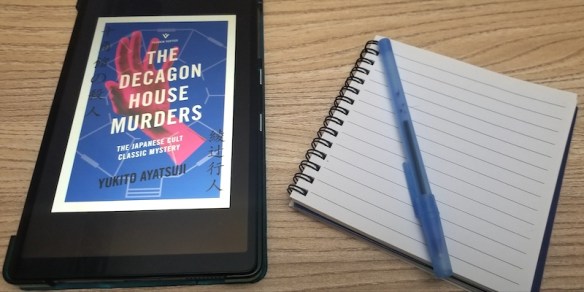
DecagonHouseMurdersDetective

New case, new writer, new detective notebook.

As a mystery (and I write this 82% in), it’s pretty good. The story follows two separate yet intersecting cases: the quadruple murder of the architect and his household six months ago, and the murders of the students in the present-day. The students on the island are desperate to identify the killer, for obvious reasons, yet the novel lacks the claustrophobic quality of And Then There Were None. I think part of it is that the scenes on the island are interspersed with scenes on the mainland, where two former club members receive mysterious letters that has them looking into the quadruple murder. So even as the students on the island have no idea why anyone may be after them, we readers are well-aware, because of the mainland story.

Still, the mystery is solid. Some of the murders appear completely random: a poisoned cigarette could have been used by anyone, and same for a poisoned coffee cup when all the cups are identical. So it’s tough to see which of the students, if any, put themselves at such risk. So as a reading experience, it did feel very much like, as Ellery calls his favourite mysteries, an ‘intellectual puzzle.’

Now, as a mystery I’m actively trying to solve, it can feel very frustrating — and I mean that as a compliment. The author had me second- and third-guessing myself throughout. No sooner would i come up with a theory than one of the characters would voice it themselves, and then I’m left to wonder: does that mean the theory is a red herring, or is it actually still valid, and the author is trying to psyche me out by bringing it into the open? One of the characters was firm on a rather far-fetched theory that, to be fair, would’ve been a very valid option as a surprise twist given what we’re expecting based on our experience with Christie’s book. But then that character brought it up so often and so adamantly that again, I’m thinking, obviously, that can’t be the answer. …Or can it? A big challenge with trying to solve a mystery that is so clearly an homage to Golden Age Detective Fiction is that you know that it’s not just the writer who knows all the tricks, but the characters do as well. So they could very well be subverting tropes just for funsies.

Even the mainland investigation into the quadruple murder has confused me. On the surface, that mystery has been neatly solved and wrapped in a bow. The problem is, I don’t know if I should trust these characters. Unlike, for example, Agatha Christie’s Cards on the Table, where her detectives are series characters so you know you can take them at their word, the detectives here are all unknown to me. There’s an eager beaver character who inserts himself into the former club members’ investigation, and in some ways ends up running it. And that kind of character is either totally suspicious, or being set up to be an eccentric series character. I just don’t know.

All to say, I do have a guess. Do I feel confident in it? Not at all. Do I have other theories I also feel strongly about? Sure, but my gut isn’t necessarily pointing me in any direction that makes sense. To be honest, I don’t really feel too strongly about any of the characters; to me at least, this story very much remains an intellectual puzzle rather than a gripping page turner. Mostly I feel confused. But the deaths have occurred, and the mainland characters have been called together, so I feel like the big reveal is coming up. So here we go!

Conclusion

Okay, this got me. From my rather detached ‘intellectual puzzling’ through it all, to a legit gasp at the big reveal. Wow.

Did I guess it? No, not at all. Or rather, my gut actually did lean towards the right answer, but then my mind got in the way and reminded me that my gut feels had no rational backing, so I went with the answer that made sense but turned out to be wrong. Bah.

So, okay, well done, Yukito Ayatsuji. Bravo.

***SPOILERS BELOW***

My Theory / My Detective Big Reveal:

Continue reading

Review | Those People Next Door, by Kia Abdullah

ThosePeopleNextDoorKia Abdullah has a gift for crafting emotionally taut page-turners charged with rapidly rising racial tensions, and Those People Next Door is no exception. In her latest novel, Abdullah introduces us to two families: Salma and Bilal Khatun and their teenage son Zain, who just moved into the neighbourhood, and their next door neighbours, Tom and Willa Hutton and their teenage son Jamie.

It starts when Salma witnesses Tom knock Zain’s Black Lives Matter sign down with a ball. She moves the sign to her window, and wakes up to find her window painted over. She confronts Tom, who claims innocence over the window, and claims he knocked over the sign not because he disagreed with the message, but because he’s a pedant about rules, and neighbourhood bylaws prohibit lawn signage. Salma doesn’t believe him, and posts a passive-aggressive tweet about “tolerant Britain” that goes viral. And things escalate from there. Their spouses get involved, their sons are forced to hide their friendship, and eventually, things come to a head. A crime is committed, an arrest is made, and the novel shifts into a courtroom drama. (Content warnings below the ‘read more’ tag. They contain some minor spoilers for the plot, but not the ending.)

Abdullah’s courtroom scenes are usually my favourite parts of her books, but that wasn’t so much the case this time. I think it’s because we watched so much of the drama unfold in real time, before we even got to the courtroom, and while it was interesting to see how the characters words are interpreted (and at times, twisted) on the stand, there wasn’t the nail-biting whodunit element that I loved so much in Take It Back.

The whole back-and-forth pettiness of Salma and Tom’s war on each other was more sad than anything. As each family escalated the battle, and each escalation brought on new stress, sorrow, and anger unto the other family, I just felt really sad for all of them, and wished they could sit down and talk it all out. Is Tom racist? Sure, he shouldn’t have said what he did about the smells of Salma’s cooking, but he paid dearly for that remark, and I can’t blame Willa for feeling angry that the video was posted even after Salma promised it wouldn’t be. Even though the tensions between the families had definite undertones of racism and class privilege, mostly, the battle was just a lot of pettiness, and the characters’ mix of exhaustion and rage as things kept escalating radiated from the page.

Against this backdrop, we have the friendship between Zain and Jamie, who have teamed up to develop an app for deaf folks. Jamie has hearing loss, and Zain is a coder, so they both bring something unique to the table. They even submit the app for a diversity startup fund, and as nice as it is to read about them working on it together, it’s also sad to see how their families’ tensions are putting a strain on their friendship.

One thing I will say is that I did not realize this book was a whodunit until the big reveal. I know who had been arrested for the crime, I was confident about who had actually committed the crime, and my assumption made me sad. The reveal surprised me, and in some ways, made me even sadder.

Those People Next Door is a fast-paced, emotionally taut book, and in some ways, also a legal thriller. But mostly, it’s a psychological study of six people. All six are doing their best to get by in this world, yet because of…well, choices, they can’t quite have the lives they want. Many of their choices are understandable, if not unavoidable, yet throughout the story, you just keep wanting to ask: you may have won this round, but at what cost?

+

Thank you to Harper Collins Canada for an advance reading copy of this book in exchange for an honest review.

Content Warnings 

(includes minor spoilers on the plot, but not the ending)

Continue reading

I Try to Solve An Agatha Christie Mystery: Murder in Mesopotamia (Hercule Poirot)

MurderInMesopotamiaOkay, this is a very, very good book. I started reading it late one Saturday evening, and had to tear myself away about a third of the way in because it was getting close to midnight and I wanted to sleep, but also, I COULDN’T PUT THE BOOK DOWN!

The premise is delightfully spooky: archaeologist Dr Leidner hires a nurse to care for his wife while she accompanied his team on a dig in Mesopotamia. Mrs Leidner has been having a tough time — she’s been hearing odd noises like scratching on the walls, and seeing stuff like, once, a creepy face at her window. The whole thing was making her extra jumpy, and Dr Leidner hoped Nurse Leatheran — who is also our narrator — can help with her nerves.

My Kindle copy had highlights galore, and the notes in my detective notebook were filled with clusters of exclamation points. Here’s a reveal! There’s a reveal! And oh my god, I can’t believe this was just revealed!!! There was a chapter where Mrs Leidner was telling Nurse Leatheran about some experiences she’d had, and I was gasping as if I were watching things unfold in a theatre. The simple phrase “I have arrived” made me jump. Seriously: a chill ran down my spine, and I clutched my poor cat for comfort. Nurse Leatheran had a much more rational response to the incident, and a matter-of-fact explanation for it. Which only goes to show me that in the world of Poirot, I’m more likely to be the ‘hysterical’ woman in need of a nurse than the level-headed nurse herself.

MurderInMesopotamia

My detective set-up includes hot cocoa, detective notebook, and (not pictured) little grey cells!

Ironically, despite the title of the novel, the murder itself took me by surprise. Partly because, shortly before it occurred, a revelation turned suspicion on a particular character. So when the murder happened and definitely proved that character innocent, I was thrown aback. But also, and this is yet another sign of Christie’s genius, the scene right before the murder was calm and low-key. Characters went off to their daily tasks, Nurse Leatheran settled in with a good book about a nursing home… and honestly, the scene lulled me into a false sense of security. So when Nurse Leatheran realized two hours had passed, and then a murder is discovered, it took a moment for my brain to catch up. So, well done, Dame Agatha, for pulling me in so masterfully!

Among all the Agatha Christie mysteries I’ve tried to solve so far, this one feels the most cinematic. In fact, when the characters call Hercule Poirot in for help at the 33% mark, I even cheered out loud. Because, the hero has arrived, and the story is about to ramp all the way up to full throttle. Poirot, as always, lays out the facts and possible theories with admirable precision, and by the 44% mark, I was ready to lock my prime suspect in as the murderer. I’d found them suspicious from the start, and further clues only seemed to confirm my suspicions. Of course, this being Agatha Christie, the level of my confidence is often in direct opposition to the level of my accuracy, and I knew many more things had yet to be revealed.

…Okay, I’m 81% in, a second murder has occurred, a character has disappeared, and Hercule Poirot has requested for all suspects to be gathered together. It’s time for me to make my final deductions. I make my bold proclamation and explain my rationale after the spoiler tag, and we shall see how my little grey cells stood up to this task!

Conclusion

Ok, hats off to you, Dame Agatha. No, I did not solve this mystery, but to be honest, I don’t even mind. Because the actual reveal blew my mind. I yelled “WHAT???” when Poirot made his accusation. I had my hand to my mouth as he explained the means the murder was committed. And I legit gasped out loud when I learned the motive. My poor cat had been cuddling with me as I read, and she shot me a look and inched away as I read these pages.

Bravo, Dame Agatha. Brilliant work!

***SPOILERS BELOW***

My Theory / My Detective Big Reveal:

Continue reading