Unknown's avatar

About Jaclyn

Reader, writer, bookaholic for life!

Review | Hungry Ghosts, Peggy Blair

HungryGhostsI’m a fan of Peggy Blair’s Inspector Ramirez series, as well as a fan of art mysteries, so when I learned that the third instalment in the series involved an art world crime (the marketing campaign included an art exhibition inspired by passages from the book), well, colour me intrigued!

Hungry Ghosts was more about a series of murders of prostitutes than about the art world crime, but it still definitely did not disappoint. Having established her world building in the first two titles, Blair now seemed freed up to focus on the intricacies of her mysteries. The characters fit in more naturally with each other than before, and the dual mysteries investigated by Ramirez and Canadian First Nations detective Charlie Pike seemed more seamlessly integrated than before.

That being said, the strength of Blair’s mysteries has rarely been about the actual case so much as it was about the political commentary these cases brought forth, both about Cuba and Canada. I particularly love how Charlie Pike was invited on a case, literally as a token First Nations representative — his experience as a detective was less valuable to his colleagues in this case than his background. This to me highlights the tense relations that still exist between the Canadian government and First Nation tribes, and while Ramirez and his Cuban mysteries are presumably the focal point of this series, Blair’s interest in and passion for First Nations issues in Canada comes through loud and clear, particularly in this story. Part of me wonders if she’ll ever do a spinoff story just on Charlie Pike, a full novel to explore the intricacies of Canadian First Nations politics.

I also love how Ramirez’s gift for speaking to the dead has become almost second nature in this story — it is still mentioned as a plot device, but much like it must be for Ramirez, it becomes here simply another tool in his arsenal rather than a defining characteristic. I love how his concerns over it tie in to his family history — bits like this flesh him out even more as a character, and make him more real.

Finally, I absolutely love the character of Hector Apiro. He is a wisecracking pathologist with dwarfism who, when asked what he’d want people to say at his funeral, quipped, “I’d like someone to lean over my casket and shout, ‘Oh my God, he’s alive!'” The mystery in this book is personal for Apiro, because of his relationship with a prostitute named Maria. Their love and affection for each other shines through, and they have some wonderful scenes of tenderness that belie the usual tough shell Apiro presents at his autopsies.

The mysteries themselves were resolved fairly neatly, and while part of me wished the art mystery was given a bit more prominence, I was mostly just glad to spend time once again with Blair’s characters.

+

Thank you to Simon and Schuster Canada for a copy of this book in exchange for an honest review.
Review | Smoke, Catherine McKenzie

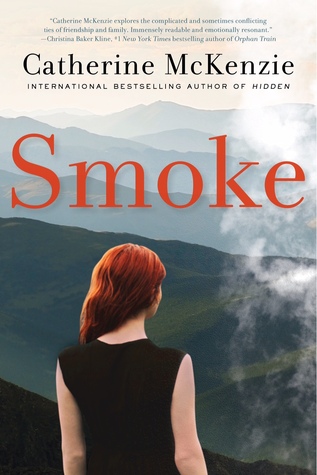
SmokeMcKenzieI’m usually a fan of Catherine McKenzie’s work, but try as I might, I just could not get into this book. The subject matter is a bit more sombre than what my previous McKenzie reads — a wildfire threatens a small community, and the story focuses on two women who live in that town. Elizabeth is an arson investigator who has been tasked with finding out how this fire started, and her ex-friend Mindy is drawn to help a man who has lost his home to the fire. The man also happens to be Elizabeth’s chief suspect, and the story presents a mixture of mystery as to how the fire started, and the various domestic dramas of Elizabeth and Mindy’s families and their community.

I love mysteries and I love small town dramas, but for some reason, this story and these characters failed to draw me in. The pace felt slow, with multiple subplots that I didn’t find confusing so much as uninteresting, and so were a struggle to keep track of. There were also a lot of characters introduced throughout the story, who weren’t really fleshed out enough to make me invested in what happened to them.

I enjoyed Arranged and Hiddenbut I struggled to get through Smoke. There were threads that intrigued me — Elizabeth’s attempt at a quiet family life, the teenage bullies, the small town corruption — but all just felt like disparate elements that ultimately fell flat.

+

Thank you to the publisher for sending me an advance reading copy of this book in exchange for an honest review.

Review | Better than Before, Gretchen Rubin

betterthanbeforeApart from a brief stint of Dr. Phil fandom, I’m not a big fan of self-help books. They usually strike me as saccharinely optimistic at best, and rigidly authoritarian at worst. This may explain why I was both intrigued and slightly turned off by Gretchen Rubin’s Better than Before.

Rubin explores the idea of habit formation, and proposes that we all fall into one of Four Tendencies, depending on how we respond to obligation: Upholders stick to both external and internal obligations, Questioners do things only when it makes sense to them, Obligers need external accountability, and Rebels do what they feel like. According to Rubin, each of these tendencies can lead to success — the trick is to understand your own tendency and structure your habit formation along those lines.

I admit bristling at these classifications when I first read about them, mostly because I realized I was a textbook Obliger. In North American society, today, where individuality and self-governance are so highly prized, it seemed to be that Upholders were the most suited to success, and being an Obliger was the surest path to failure. Ironically, just a few pages after I felt this, Rubin writes that of the four Tendencies, Obligers are the most likely to dislike their own tendency.

Fortunately, as I read on, Rubin spoke at length about her sister — an Obliger — who is diabetic and who succeeded in getting her blood sugar down by changing her eating and exercise habits. For Rubin’s sister, it helped for her to tell co-workers that she no longer ate cupcakes, because they then helped hold her accountable to that resolution.

Rubin also gives various examples of friends and family members with other Tendencies, who successfully formed new habits based on her techniques. Honestly, I think her friends and family were a lot more polite than I would have been, if someone offered to make me a “guinea pig” in their habit formation theory. Rubin claims to understand that what works for her (an Upholder) will not work for most other people (most people are either Questioners or Obligers), but apart from a nominal split second of reluctance, she seems to have no problem dictating habits that her friends and family should form. Still, it is gratifying to know that even Rebels and Questioners can be successful at forming habits.

Also of interest are other classifications Rubin posits. One can be a Lark or an Owl (work best at daytime or at night), as well as an Abstainer or a Moderator (give up chocolate entirely or limit oneself to a square of chocolate a night). Again, alongside the Tendencies, these are useful in determining how to form new habits. For example, Rubin’s sister couldn’t commit to giving up all carbs to help her blood sugar, but she committed to abstaining completely from French fries, and that in itself has improved her health.

Rubin also calls us out on relying on loopholes — e.g. the “tomorrow” loophole, where we plan to begin a new habit “tomorrow” and in the meantime, splurge for today. Or the “false choice” loophole, where we set up a false dichotomy between two competing values that may not necessarily be in opposition (e.g. I can’t exercise because I work so hard).

I wish Rubin had spent more time talking about strategies for the other Tendencies, rather than relying on personal anecdotes sprinkled throughout. I also wish she had expanded the scope of the habits she chose to speak about — she mostly focused on habits she deemed important for herself, e.g. a low carb diet and exercising.

Finally and most problematically, I thought that at times, she framed concepts and redefined terms in a way to suit her arguments. For example, she says we can’t use rewards to help us with our habits because then we’re doing things for the reward and not viewing the habit itself as a reward — this strategy may work for Upholders, but likely not for everyone. Worse, she then says we can have treats, as long as they’re not tied to a particular habit or seen as a reward — this strikes me as just semantics, and is disingenuous. For example, when someone suggests that Rubin give up her diet soda habit to be healthier, Rubin emphatically declares that diet soda is her treat, and because she doesn’t smoke and barely drinks, she is entitled to it. I couldn’t care less if she drinks diet soda or not, but her tone struck me as defensive, and makes me wonder why her drinking diet soda as a treat is justified whereas her sister eating carbs beyond French fries is given the side eye.

Still, I thought the classification of Tendencies was useful, as were the details on loopholes and strategies we use that may hinder our habit formation. Rubin’s strategies for herself will definitely not work for me — she may thrill in structuring her days to such an extent, but I would chafe under such rigidity (e.g. scheduling a time each night for her and her husband to talk about their day) — but understanding that I’m an Obliger will definitely help me with my own habits. For example, it now makes sense why my whole strategy of going to the gym without a fixed schedule didn’t work for me — I enjoy the solitude of working out alone, but may need the accountability of a group class where people know me and would know if I skipped a class or two. Whatever your Tendency is, you can form a strategy for success, and Rubin’s book — particularly the first few chapters — can help you form that strategy.

+

Thank you to Random House Canada for an advance reading copy of this book ine xc