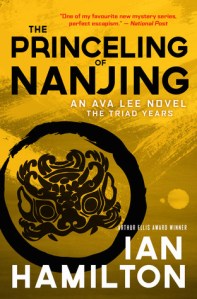
 The Princeling of Nanjing is the best Ava Lee book I’ve read in a while. Hamilton’s books are often very action-packed, which sometimes makes it easy to forget that Ava Lee isn’t a superhero vigilante but rather a forensic accountant. Princeling features several chapters of pure, unadulterated financial sleuthing, which both gave me some nerdy feels and tickled my puzzle-loving mind.
Princeling begins with the launch of Ava’s business’s fashion line, but quickly turns its focus onto the business troubles of Ava’s friend Xu. A Triad boss who bribes powerful families to keep his businesses afloat, Xu is facing pressure from the Tsai family to manufacture synthetic drugs. The Tsais are the most powerful family in Nanjing, its patriarch the titular “Princeling” of the region, and while Xu wants nothing less than to return to drug manufacturing, he knows that disobedience may mean his other businesses will be taken down.
I love a lot of things about this book, first being how clearly Ava misses her old work with Uncle. By co-founding the Three Sisters business, Ava appears to have entered a new chapter in her life, and left her work with Uncle completely behind. Princeling shows that Ava isn’t pulled into her old ways reluctantly, and in fact Xu hasn’t asked her for help. Rather, it’s Ava’s own desire for that old adrenaline rush that prompts her to help, and this in turn helps her realize how much her old job has become an inescapable part of who she is. To that end, what somewhat annoyed me was Ava’s naivete in thinking that the Tsais wouldn’t notice her investigation or that they wouldn’t connect it to her. After seven novels and countless more cases, I’d think Ava would know better.
The other thing I love so much about this book, as I mentioned earlier, is all the financial puzzle-solving that happens. In order to take down the Tsai family, Ava follows the money trail of their various companies. Hamilton takes us step by step through her investigation, and presents us with flowcharts that show just how extensive the Tsais’ network is. It’s fascinating, and I love seeing Ava’s brain work. This being an Ava Lee book of course, there is the requisite bak mei scene and the requisite big violent confrontation scene. Those are fine, but it’s really in the brainstorming scenes that I think Ava Lee shines the most.
Princeling may have been the best Ava Lee book I’ve read in a while, but it also highlighted some weaknesses of the series in general. I’ve mentioned in my review of an earlier book that Hamilton sometimes uses easy stereotypes when attempting to depict a particular culture (the Philippines in that particular instance). In Princeling, I came across this line that just made me cringe: “It sure beats doing business on Negros Island in the Philippines, or a hundred other backwaters I’ve worked.” “Backwaters,” Mr. Hamilton? Really? I read the Advance Reading Copy, and I hope some editor strikes that line before the final print.
As well, so many characters commented on how extraordinarily beautiful Ava is, with Ava demurring each time that she really wasn’t. Unsure why I found this annoying, though I think it’s partly because Ava seems so perfect she’s almost superhuman. She displayed some vulnerability in an earlier book when she was worried about Uncle’s health, but otherwise, there’s a coldness and detachment in Hamilton’s dialogue that makes me somewhat imagine Ava to be a replicant from the film Blade Runner.
This sense of detachment also results in an artificiality to some of the cultural references. When mentioning some aspects of certain cultures, characters sometimes come off more like tour guides than people who live within that culture. Take the following dialogue for example:
“Where are you from?” Pang said. “Your Putonghua has a distinct accent.”
“I’m Canadian, and there we most often refer to it as Mandarin.” (p. 21)
I can understand that Hamilton is writing for a non-Chinese audience who may not recognize the term “Putonghua.” But it just sounds a bit off in terms of actual conversation. I think that’s what also strikes me as a bit off about some of the descriptions, and while I understand that Hamilton has to balance natural characterization with clarity for an international audience, I wish he had done it more smoothly. I wish that his characters feel like they’re acting within their world rather than explaining their world to us.
That being said, this still is the best of the Ava Lee series to date, and I thoroughly enjoyed the read even with my reservations above. The next instalment is The Couturier of Milan. Fashion and Milan — I’m definitely excited for that!
+
Thank you to House of Anansi for an advance reading copy of this book in exchange for an honest review.


 I love Kelley Armstrong’s work, and The Masked Truth is no exception. A group of troubled teens spends a weekend in therapy camp, and are taken hostage by a group of masked men. It’s a scary premise, and Armstrong lives up to expectations, keeping the pace on an adrenaline high throughout.
 Imagine if a medical procedure could transfer your consciousness into a perfected version of your body. Imagine if cancer, AIDS and all sorts of illnesses can be cured, and those afflicted could wake up one morning in a perfect copy of their body, minus whatever genetic or cellular matter led to the disease in the first place. It sounds like the set-up for a Gattaca-type thriller, and I was pleasantly surprised that Jessica Chiarella’s
