
Unknown's avatar

About Jaclyn

Reader, writer, bookaholic for life!

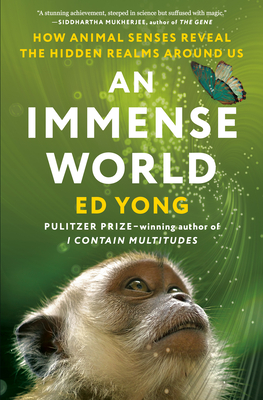
Review | An Immense World: How Animal Senses Reveal the Hidden Realms Around Us, by Ed Yong

AnImmenseWorldThere’s a fantastic scene in the Dungeons and Dragons movie where the druid Doric transforms into multiple animals as she races out of a castle and across a field after a spying mission. Much of the scene is shown through her perspective, so even better than seeing her switch into a mouse or a fly or, later on, a deer, we actually see the world through the eyes of a fly or a mouse or a deer. It’s a fantastic bit of cinematography, and an exhilarating five or so minutes.

Ed Yong’s book takes us on a similar journey. He shows us how a broad range of animals experience the world, and makes a very deliberate effort to focus on these animals as themselves and not how they relate to humans. He does use human experiences in comparison, to help us understand how each animal experiences sights or smells or touches, but the overall impression is that of being taken through experiences very much alien to us readers. Rather than anthropomorphizing the animals he talks about, Yong invites us to be animorphized into animals (is that the word?).

The result is an incredibly fascinating deep dive into animal life. What must it be like to see in multiple directions at the same time? How must the world seem to someone who can taste with their feet? How much incredibly richer are the scents of the world to a dog than to a human? There’s a particularly cool bit about a kind of insect that has sex near forest fires, and the reason is that the fires chase away this insect’s predators, and so makes the forest safe and food sources easier to access for them and their families.

And on a more sobering note — why are some human actions so harmful to animal life? I’ve heard the stats before of how city lights kill lots of birds every year, but this impact hits different when you read about why darkness is so important for birds when they migrate. In the case of the insect that has sex near forest fires, the smoke from backyard barbecues can mess with their perceptions by making them think there’s a forest nearby that would be a safe place for them to have sex and raise their little insect babies.

The book is chockfull of scientific facts, and as fascinating as it is (my kindle copy is filled with highlighted passages), it does take a bit of time to get through. I also doubt I remember enough to actually answer questions about individual animals I read about. (For example, I think the forest fire sex insects are a kind of beetle, but I wouldn’t be surprised if I got that wrong altogether, as that was from an early chapter and I would’ve read that maybe a month ago.) Still, this is just a good reason to buy a copy of the book for yourself, rather than borrowing it from a library. (I initially borrowed it from the library, but then realized I wanted to highlight so many things that buying my own copy made more sense.) It’s the kind of book I can imagine dipping into over and over again, and honestly, I’m even considering buying a paperback copy so it’s a bit easier to casually flip through whenever I get in the mood.

There are some disturbing bits about the experiments scientists had to do to learn some of these facts. Like, I think these were done on ants? or some other kind of insects? where the scientists removed one or more of their senses to get a better understanding of how these insects navigate the world. That was hard to read, and part of me does feel like the learnings really aren’t worth making the animals suffer like that. But at the same time, I do find the learnings so fascinating that I’m planning to own two copies of this book. And Yong does do a good job of highlighting how conflicted some of scientists themselves are about their actions — a lot of them go into the field of studying animals because they love animals and are fascinated by them. So while I wouldn’t go so far as to say I sympathize with these scientists, I also recognize my own complicity in their actions, and would be hypocritical to blame them.

Overall, I LOVE how this book focuses so much on the animals as themselves. There isn’t much about how this or that understanding of animals’ lives and behaviours are being used to help medicine and planning for humans. Rather, the animals are, and remain, at the center of Yong’s writing, and it is us as humans who take the back seat in this deep dive of their world.

I Try to Solve An Agatha Christie Mystery | Evil Under the Sun (Hercule Poirot)

EvilUnderTheSun

Fresh off my double victories over Agatha (see: Five Little Pigs and Peril at End House), I dove into Evil Under the Sun with considerably more confidence than usual. After all, I’ve bested the Queen of Crime twice; surely, my little grey cells are more than up for this classic Poirot case?

Alas, I was barely halfway through the book when I realized how misplaced my confidence — okay, cockiness — was. There’s so much going on in this novel, and so many suspects (and I’m sure, red herrings) to consider, and I have no clue what the answer will turn out to be! In a further blow to my ego, Poirot lists all the clues he’s mulling over. He also literally points out to us readers what details are significant, and he asks highly specific questions that clearly draw our attention to important elements. And I still have no idea who on earth could have killed Arlena Stuart Marshall!

The set-up is classic Christie: Poirot is on holiday at a sunny beachside resort. He meets a cast of colourful characters, many of whom are entangled in each other’s lives in one way or another. At the centre of the main plot is Arlena Stuart, a beautiful woman who draws men to her with barely any effort. Her husband, Captain Kenneth Marshall, and teenage stepdaughter Linda are on holiday with her. Another guest at the resort, the super handsome Patrick Redfern, seems infatuated with her, to the dismay of his wife, the pale and plain Christine Redfern. Entangled with them all is Miss Rosamund Darnley, a smart boss lady type who runs the local boutique, was childhood friends with Captain Marshall, and seems to still hold a torch for him.

One beautiful morning, Arlena’s body is discovered on Pixy Cove, killed by strangulation. She was discovered by Patrick and another guest, Miss Emily Brewster, who is described as tough and athletic. Other characters include an American couple, Mr and Mrs Gardener; Major Barry, who is a bachelor and gambler; Rev. Stephen Lane, who is obsessed with “scarlet women”; and Horace Blatt, who seems desperate to be liked. There are also a couple of subplots that involve some of the characters, and may or may not be linked to Arlena’s death.

I have my ideas about how all the puzzle pieces fit together, and I’m very much not confident I’ve figured it out. But then again, the last time I felt this uncertain (At Bertram’s Hotel) , I ended up figuring out about 75% of the mystery, so maybe I’ll have similar (or better!) success this time around!

Did I Solve the Case? (No Spoilers)

No, no I did not. Not even close. Sigh… I had two very strong gut feel suspects, and both of them turned out to be innocent. Not only did I not guess the murderer’s identity, I also did not guess their motive or method.

Okay, Dame Agatha, you win this round. And very well-played too, I must admit. That was a mind-blowing reveal.

Onward and upward, little grey cells! We’ll solve the next one!

***SPOILERS BELOW***

Continue reading

I Try to Solve a Dorothy L. Sayers Mystery | Whose Body? (Lord Peter Wimsey)

WhoseBody

Fresh off my recent victories with Dame Agatha’s work (woohoo!), I decided to give her contemporaries a try. First up: Dorothy L. Sayers, a founder and early president of the Detection Club, to which Christie also belonged, and which set up the whole “fair play” rules for detective fiction in the first place.

Sayers’ best-known mysteries are the Lord Peter Wimsey series. I tried reading the first book Whose Body? over a decade ago, and found it too boring to finish, but I decided to give it a go again this year, and see if perhaps pitting my wits against her sleuth made the story more compelling.

And… it did. It still took me over three months to finish the book — an especially long time considering it’s only 197 pages long. I’m afraid that as great a writer as Sayers is — and there are some sections in the book that are just *chef’s kiss* stylistically — I’m never going to devour her mysteries like I do Christie’s. And I’m not sure why either. Her writing is a bit like Agatha Christie meets PG Wodehouse, and those are two of my favourite authors, but for some reason, I struggled with Sayers’ writing.

Regardless, Whose Body? has an incredible hook for a mystery: a man discovers a dead body in his bathtub. The body of the dead man is naked, except for a pair of pince nez (a kind of eyeglasses) on his face. He bears a remarkable resemblance to Reuben Levy, a wealthy Jewish financier who went missing the night before, yet there are enough differences that the body clearly is not the financier’s. Detectives check the local hospital, and there are no bodies missing from their morgue. Whose body is it, and where is Reuben Levy?

Did I Solve It? (No Spoilers)

Well, yes, but I don’t think it’s as big a cause for celebration as solving an Agatha Christie mystery is. Unlike Hercule Poirot or Miss Marple, Lord Peter Wimsey is pretty open about his thought processes, so the killer’s identity was easy to figure out.

The couple of red herrings that came up were revealed as such fairly quickly, often with Wimsey pointing out how they didn’t fit the physical evidence. Now, with an Agatha Christie book, that wouldn’t necessarily mean the characters are definitely innocent, so I continued to keep them on my suspect list.

But then emerged a suspect who knew Levy, had a motive for getting him out of the way, and had a connection to the man in the tub. At first I thought it couldn’t be this person; they were too obvious a suspect, especially given that the relevant information was revealed only about halfway through the book. But then I flipped back to earlier chapters to see earlier scenes with them, and what I found only confirmed they had the opportunity to carry out the crimes.

And sure enough, it wasn’t long before Lord Peter confirmed my suspicions. I suppose I can feel proud that technically, Lord Peter took an extra chapter or two after I figured it out to reach the same conclusion. But again, I don’t think Sayers was being particularly sneaky about her reveal to the reader, so I think I figured it out precisely when the author intended me to.

My Verdict on Dorothy L. Sayers and Lord Peter Wimsey

She’s an incredibly skilled writer. There’s a wonderful passage late in the book:

When lovers embrace, there seems no sound in the world but their own breathing. So the two men breathed face to face. (page 174)

It’s so masterfully written; you can practically feel the charge in the air as Lord Peter Wimsey makes eye contact with the murderer.

Through Lord Peter’s dialogue, Sayers also shares some gems about detective fiction:

“That’s just what happened, as a matter of fact,” said Lord Peter. “You see Lady Swaffham, if ever you want to commit a murder, the thing you’ve got to do is to prevent people from associatin’ their ideas. Most people don’t associate anythin’ — their ideas just roll about like so may dry peas on a tray, makin’ a lot of noise and goin’ nowhere, but once you begin lettin’ ’em string their peas into a necklace, it’s goin’ to be strong enough to hang you, what?”

“Dear me! said Mrs. Tommy Frayle, with a little scream, “what a blessing it is none of my friends have any ideas at all!”

“Y’see,” said Lord Peter, balancing a piece of duck on his fork and frowning, “it’s only in Sherlock Holmes and stories like that, that people think things out logically. Or’nar’ly, if somebody tells you somethin’ out of the way, you just say, ‘By Jove!’ or ‘how sad!’ an’ leave it at that, an’ half the time you forget about it, ‘unless somethin’ turns up afterwards to drive it home.” (page 117)

It’s a brilliant piece of writing. Light, funny, and with nice comic touches like the part about Lord Peter frowning at the duck on his fork (I love how she phrased that!). It’s also sharp and incisive commentary about some of the conventions of detective fiction and how unnatural it is to have the important clues and evidence laid out so neatly for the reader.

As someone trying to solve this mystery with Lord Peter, it’s also a sly invitation to look more closely at information I may have easily overlooked earlier on, because they may be important. And indeed, when I re-read sections from earlier in the book to confirm details about my suspect, I had to applaud Sayers for how masterfully she sprinkled relevant details into the narrative. There’s good reason I didn’t suspect this person until Sayers meant to reveal them as suspicious, and kudos to the author for that. She also later mentions a highly telling clue that I missed altogether, so that was a nice new bit for me to realize after the fact.

Ultimately, despite my admiration for her writing skill, I don’t think I’ll continue with Dorothy L. Sayers’ Lord Peter Wimsey novels. Her style just isn’t a page turner for me, and the mystery element isn’t enough of a puzzle that I’ll want to keep trying to solve them. Still, I’m glad I read this. Her approach is so different from Agatha Christie’s that this gives me a better idea of what golden age detective fiction was like, and this book in particular gave me a better appreciation for how a mystery like The Honjin Murders is structured.

***SPOILERS BELOW***

Continue reading