Unknown's avatar

About Jaclyn

Reader, writer, bookaholic for life!

I Try to Solve an Agatha Christie Mystery | Hallowe’en Party (Hercule Poirot)

HalloweenParty

I’d given up on trying to solve Hallowe’en Party, because I couldn’t wait any longer to see the Kenneth Brannagh film adaptation A Haunting in Venice. But when I started reading the book again, I realized that the story was so drastically different that the motives and circumstances behind the crime, and possibly also the murderer, must be different in the book.

So, flush with my success in solving the movie version of this mystery, I decided to try my hand at the book. I’ll admit that my first attempt in trying to read this book and solve this mystery gave me a bit of a headache. Not only did we not know who the murderer was, we also didn’t know who their original victim must have been!

See, in the book version, Joyce Reynolds isn’t a psychic medium hired to channel the spirit of Rowena Drake’s dead daughter. Rather, she was a thirteen year old child who claims to have witnessed a murder a few years ago, but didn’t realize it was a murder until only recently. So when she turns up dead in the bucket used for bobbing for apples, it seems reasonable to assume that she was killed by whomever had committed that first murder, to keep her from revealing their identity.

Except that Joyce never actually said whose death was actually a murder, and so the next few chapters have Hercule Poirot basically compiling a list of mysterious deaths in the area over the past few years. The list of suspects, potential victims, and potential murders kept growing, and as much as I tried to keep track with my handy dandy notebook, my head hurt with trying to figure out what’s actually important information versus what’s just noise. It’s only on my second attempt to read it, and after watching the movie, that I think I managed to get some of the information straight.

There’s a shop assistant Charlotte Benfield who was killed on a footpath, and her two ex-lovers are suspects. There’s a schoolteacher Janet White who was killed on another footpath, who told her flatmate (and possible lover?) that there’s a man she was worried about.

There’s also a wealthy widow, Mrs Llewellyn-Smythe, who died of heart failure. Interesting note here is that her will had a handwritten codicil leaving everything to her au pair, Olga Seminoff. The codicil was later determined a forgery, Olga goes missing (but keeps writing letters to a friend for at least six months after), and Mrs Llewellyn-Smythe’s estate instead goes to her niece and nephew, Rowena Drake and her husband. (Like the movie, Rowena also hosted the Halloween party. And I don’t think the movie covered her husband, but here, he was disabled and died in a car accident.)

There’s also Lesley Ferrier, who was knifed in the back. He’s a notorious womanizer and the general consensus is that the husband of one of his lovers killed him, but he also worked at the law firm representing Mrs Llewellyn-Smythe’s estate, so hmm…

Poirot also seems really interested in Mrs Llewellyn-Smythe’s sunken garden, which she created with the aid of Michael Garfield, a handsome landscape architect. She left him the garden and a house as long as he kept it up for visitors to enjoy, but it seems he sold it to someone else? There’s also a scene that gives me weird vibes, where Michael sketches a 13-year-old girl, Miranda, who was Joyce’s best friend. She keeps asking where the wishing well is in the garden, and Michael tells Poirot he pretends there is one for her sake, but there really isn’t; there used to be a lucky tree but it was struck down by lightning. Anyway, the creepy vibes I got were from the adult man just randomly sketching a young girl and saying she’s someone he wouldn’t forget even when he moves away. Eww?

Back to the mystery: which death did Joyce witness and recognize only later as murder? Who was the murderer? And given that barely anyone at the party paid Joyce’s story any attention, why even bother killing her over it? And perhaps some of these stories are just noise, but perhaps also some of them are relevant. How?

This book is far twistier and more convoluted than the movie adaptation, for all the ghosts and jump scares Brannagh added in. I have a wild guess, but my gut is that my guess is far more convoluted than the solution actually is.

Did I Solve It?

Huh, I actually did. Or rather, I solved a chunk of it, and the remaining pieces of the puzzle were only possibilities I mentioned in passing but didn’t actually bother to consider in full. So, not quite feeling like it’s cause for a full celebration, but more feeling confused that I actually did figure most of it out. That’s pretty cool.

This is such a twisty Christie, and I’m not sure how I feel about it yet. I do appreciate how it confused the heck out of me, but also, I’m not sure I enjoyed her writing in this quite so much as in some of her earlier books. Poirot’s observations get a bit philosophical / poetic / flowery at times, and he makes some off-the-wall observations that feel Marple-esque but don’t quite work as well with him. Possibly all part of Poirot being older in these stories, but I think I prefer his earlier mysteries.

*** SPOILERS BELOW ***

Continue reading

Review | Colour Yourself to Calmness, by Sue Coccia

Cover

Just in time for the long weekend, Sue Coccia’s colouring book Colour Yourself to Calmness arrives in the mail! I’m not usually a fan of mandala-style colouring books — it can be really stressful trying to keep track of all those teeny tiny patterns! — but I’m definitely making an exception for this one.

Coccia’s illustrations within the primary outlines on each page aren’t actually patterns, but rather animals and nature images. Take for example this detail from Coccia’s illustration of a lynx. I’m afraid I don’t understand the significance of the deer (stag?), mushroom, and rabbit, but I absolutely love how the image makes me want to learn more about why the artist chose these particular images to go with the lynx. And whether or not I ever learn this, I do enjoy colouring nature images, and I’m excited to take my coloured pencils to these!

LynxCloseup

The Introduction gives us a glimpse into Coccia’s fascinating process: rather than starting with the outline and filling it in with her nature imagery, Coccia starts in the middle and works outward, developing the story as she goes. For example, the illustration for Frog has Bear in the center, who has “great inner strength [and] ois living abundantly along the love and protection of Turtle.” Dragonfly in Frog’s head represents transformation and enlightenment in Frog’s dreams, and the presence of Whale and Snake in the illustration also have meaning that feed into Frog’s broader association with prosperity, healing, and inner peace. Frog

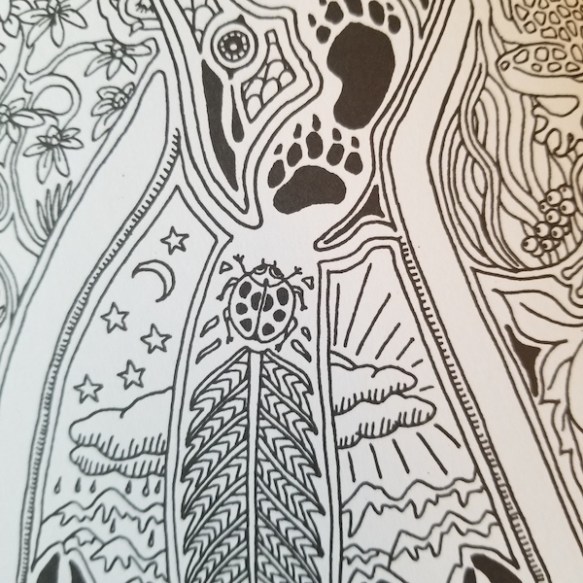
Each page also has a ladybug embedded in the image. This is Coccia’s signature; ladybugs represent good luck, happiness, and prosperity. See for example this detail from Raven’s page below. I love the powerful symbolism of the ladybug crawling upwards in between nighttime and rain on one side, and the sun beginning to peek out from behind the clouds on the other.

Ladybug on RavenAccording to the introduction, Coccia’s grandmother was Cherokee, and the artist “uses Native American, Polynesian, and Aboriginal images to show that we’re all connected in some manner.” The pages of this book give us a glimpse into some of the meanings associated with each animal; I imagine folks who are more familiar with the various nuances of these meanings will take even more out of the colouring experience.

A couple more pages I’m excited to colour are below. Mostly because I just really like big cats and hummingbirds!

Lynx and RavenHummingbird and Rose

And if there are any animals you have a particularly soft spot for, here’s the full list of all the images:

Contents

+

Thank you to Firefly Books for a copy of this colouring book in exchange for an honest review.

Review | Pinoy Practical Magic tarot and Tanim oracle, by Chinggay Labrador

PinoyPracticalMagic

Pinoy Practical Magic

TanimOracle

Tanim Oracle

A friend just brought these cards over for me from the Philippines, and I love them so much I had to gush! I purchased both decks from Practical Magic, the website of Filipino tarot creator and reader Chinggay Labrador. I love how both decks feel so very Pinoy, and folks who know both Tagalog and tarot will find lots of layers to unpack.

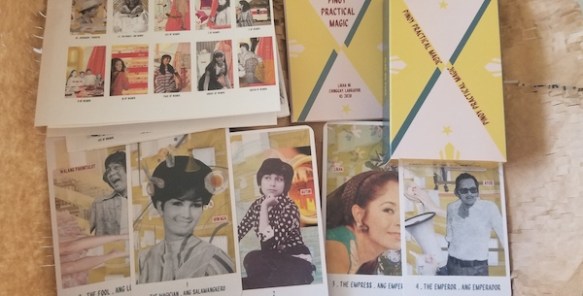
The Pinoy Practical Magic tarot is a collage-style deck that uses photos from 1970s showbiz magazines. I love the Philippine flag-inspired backs, the national anthem lyrics on the back, and I especially, absolutely love the Tagalog translations of the majors, and the Tagalog keywords on all the cards. As an example, the High Priestess card is called Babaylan and its keyword is “kutob.” And yes, tarot readers may know that the High Priestess card is all about intuition, but for a Tagalog speaker, the word “kutob” just hits different.

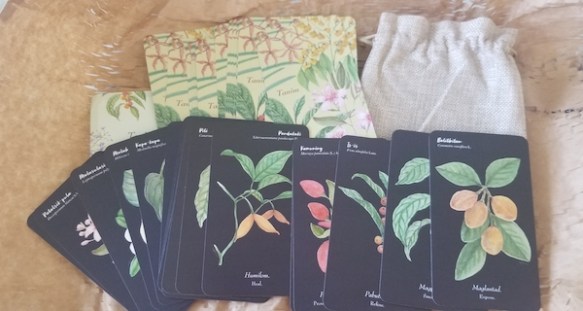
The Tanim Filipino botanical oracle deck features illustrations of plants in the Philippines and keywords in both Tagalog and English. I mostly love this deck because it’s making me nerd out over botanical information. It doesn’t come with a guidebook, so for people like me who know next to nothing about plants, you would need to look up the plants online. In reading with this, I usually read up on the plant, and then figure out how it aligns for me with the keyword on the card.

Language also plays a part in this. For example, the keyword for Philippine teak is “Manganib. Be wary.” The choice of “manganib” (which denotes danger) over the milder “mag-ingat” (take care) carries quite a bit of weight, and this nuance made me deep dive into what may be significant about Philippine teak. I also love the choice of “tanim” (to plant) rather than “halaman” (a plant) as the name of this oracle deck. It denotes an action, an invitation to plant whatever card you pull into your daily life.

Looping back to the Pinoy Practical Magic deck, I especially love how the keywords paint a vivid picture of the differences between the court cards.

Take for example the Queens:

  • Queen of Wands: Bongga (not sure how to translate this… kinda like expressing yourself fully and openly)
  • Queen of Swords: Magpakatotoo (be true to yourself)
  • Queen of Pentacles: Aruga (care)
  • Queen of Cups: Unawa (understanding)

Or the Kings:

  • King of Wands: Astig (not sure how to translate this, TBH… kinda like cool? awesome?)
  • King of Swords: Dunong (intelligence)
  • King of Pentacles: Mamahala (the ruler)
  • King of Cups: Pakisama (getting along)

For me, the Wands in the above examples are a great representation of why I love the Tagalog keywords so much. There are cultural nuances that don’t quite translate, and that add to the way we can read each card.

Other examples I love from the suits:

  • 2 of Cups: M.U. (mutual understanding… a rather old-school term for a romantic couple who haven’t quite made it official yet)
  • 3 of Cups: Barkada (a friend group, but also kinda more than that? More like your core friend group, maybe.)
  • 6 of Cups: Senti (sentimental, again a Filipino colloquialism)
  • 3 of Swords: Bigo (romantically rejected, and again, seeing the Tagalog word hits harder)
  • 9 of Swords: Bangungot (nightmare, but more like the kind of nightmare that comes with sleep paralysis and can make you feel like you’re truly trapped and going to die)
  • 3 of Pentacles: Bayanihan (a Filipino cultural practice where the entire community comes together to help each other out)
  • 5 of Pentacles: Tamlay (no energy)…I find this an interesting choice for the 5 of Pentacles, which I’ve always associated with poverty. This particular card invites deeper reflection for me, and perhaps a deeper dive into all the potential meanings and nuances within 5 of Pentacles.

Even better, this tarot deck comes with a set of stickers you can use for journaling. Perfect for deep dive reflections into the readings!