
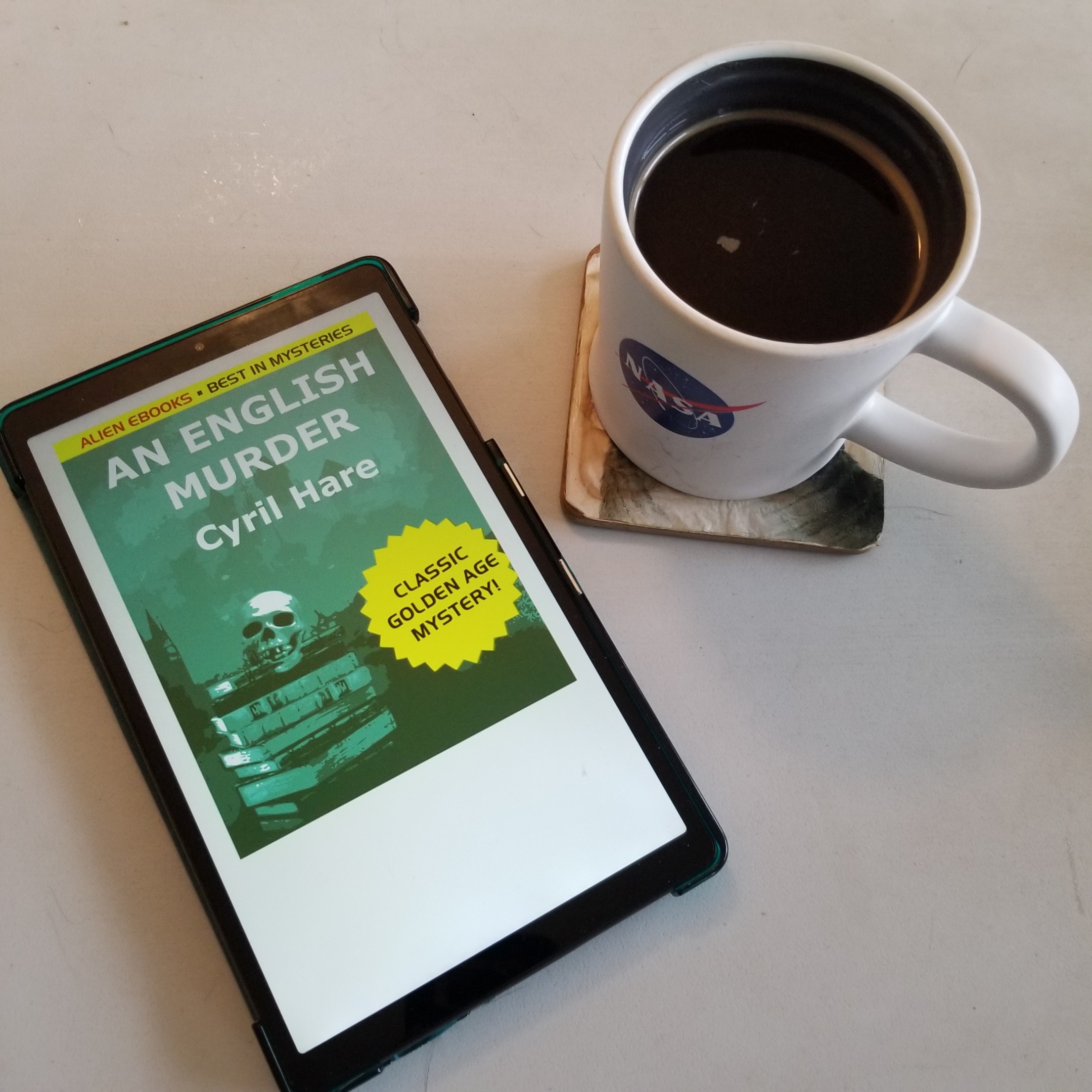
I looked up Cyril Hare’s An English Murder at my local library after seeing it listed in The Guardian as one of the Top 10 Golden Age Detective Novels. I’m always eager to expand my grey cells’ repertoire beyond Agatha Christie (and perhaps even give my inner detective a fighting chance every now and then!), so I decided to give this a go.
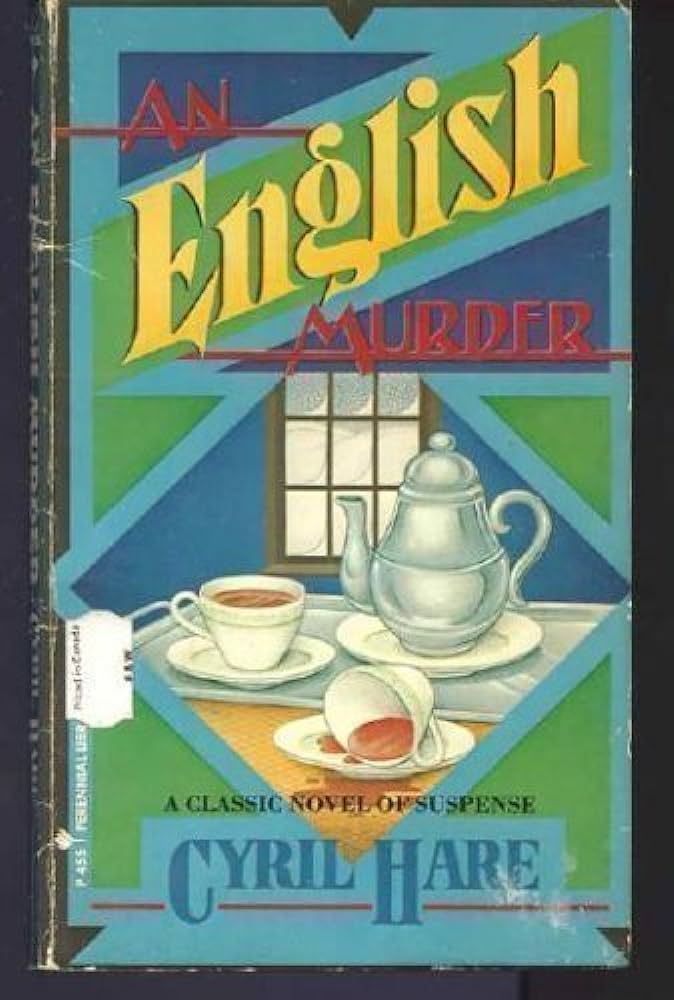
First, I’ll say I was almost turned off by the cover design. Having never read this author before, I was too cheap to purchase a copy with a better one, but just for my own satisfaction, here’s the gorgeous cover of the original 1951 mass market paperback edition:
The set-up is one of my favourites: it’s Christmas at Warbeck Hall, a beautiful and old English country estate, and family and friends have gathered to celebrate the season. On the guest list are: a socialist politician, the leader of a fascist group, an earl’s daughter nursing unrequited love for the fascist, the ambitious wife of a mid-level government worker, and a Jewish history professor and concentration camp survivor who is researching the family’s history. In the servant’s hall are: the family butler, his daughter, and the police officer acting as the politician’s bodyguard. Add in a winter snow storm, a rather juicy secret, and a dying patriarch, and to paraphrase Sherlock Holmes, murder is certainly afoot.
I love how this story touches on the politics and economic realities of post-WWII Britain. Briggs the butler comments on the challenges of putting on a party with such a small household staff. He and his daughter Susan also represent two generations’ approaches to generational wealth, with Briggs being bound by social order and Susan wanting to do away with it. Sir Julius and Robert Warbeck lock horns over competing politics: Sir Julius thinks Robert’s fascism is reprehensible; Robert views Sir Julius’ socialism as being a traitor to their class.
Dr Bottwink’s experiences at a concentration camp are mentioned only in passing, but he isn’t shy to tell Briggs he’d prefer not to eat with Robert. And when Sgt Rogers later comments at how much Dr Bottwink has moved around, the professor corrects him that it’s more accurate to say he was moved, and that this circumstance has turned him leftist — not quite communist, but “anti.” There’s a great moment after the first murder where Dr Bottwink is first to breakfast, and he asks Briggs not to leave the dining room till the next guest arrives. Life experiences have taught him to be cautious: on the off-chance someone dies at this meal, he can’t afford to have been left alone with the food at any time. Neither Briggs, nor Sir Julius who arrives next, both of whom are Englishmen, even realize why that could be a risk.
The mystery itself unfolds at a quick and entertaining pace. Events occur, information is revealed, and tea and champagne are served. I have a feeling that when the big reveal finally unfolds, the killer’s identity and motive will turn out to be so utterly obvious that I’ll hang my head in shame that I didn’t guess it at all.
The thing is, the first murder is easy enough to predict. The victim is someone whom pretty much everyone else at the estate had reason to hate, so when they declare they have a big announcement to make, and then promptly drink a glass of champagne, it’s no big loss when they drop dead. Figuring out whodunnit is trickier, because so many people had motive to.
But then two more deaths follow, and the third death in particular doesn’t fit the pattern at all. Who could have wanted that third person dead? How does their death fit in with the other two?
I have my theories, and none of them make sense. Alas, I’m reaching the 90% mark of the ebook, and things are beginning to wind down. So I’m going to give this a go, and see how I do!
UPDATE: Some significant new clues in the penultimate chapter! I may need to revise my verdict… Now at the start of the final chapter, and it’s now or never to lock my verdict in!
Did I Solve It?
Ahahahahaha! Absolutely not! Not even close! In my defence, the reveal hinged on a bit of history and law that I knew absolutely nothing about, so despite all my research, all my careful note-taking, and all the workings of my poor little grey cells, there is absolutely no way I would have guessed that motive. Honestly, I had to read the final chapter twice over just to make sense of the key information that formed the motive, and by the second time, I was laughing out loud, because never was any of that even on the horizon of my knowledge.
Would British readers be better equipped to solve this case? Would history buffs? Possibly. I’m sure there are many, much smarter readers out there who could try their hand at this and find the solution super obvious. I didn’t, and in a rare occurrence amongst my many detecting failures, I don’t actually feel like I should have been able to put the clues together. Man, this case was wild! And a lot of fun to try and solve, failure or no!
*** SPOILERS BELOW ***
My Questions:
- Who killed Robert and why?
- Who told Lord Warbeck that Robert was dead?
- Was it the shock of Robert’s death that eventually led to Lord Warbeck’s own, or was Lord Warbeck also murdered?
- Who was the poisoned tea actually meant for, Mrs Carstairs or Lady Camilla? If it was meant for Mrs Carstairs, why on earth would anyone want her dead?
- What’s the significance of Mrs Carstairs’ wet shoes?
A Clue:
When Dr Bottwick saw a biography of William Pitt, he remembered something that did not happen in 1788 or 1789. He found it significant like the dog that did not bark in a Sherlock Holmes mystery, and it made him realize something about Robert’s death.
I actually had to research what this could be, and I think it’s the fact that in 1788, the king fell victim to a mysterious illness. His son Prince George was supposed to be declared regent, but Parliament kept debating the regency thing, so that the prince never actually had the chance to take on the role before the king recovered. This was fortuitous for William Pitt, because Prince George was allied with Pitt’s detractors, and he likely would have dismissed Pitt if he’d come into power.
My Suspects:
- Susan
- Robert secretly married her a year ago and they have a son, but Robert refuses to tell his father about them. She wants her and her son to take their rightful places as heir to the Warbeck title; she has the marriage certificate to prove her claim; and Robert’s reluctance to speak up is in her way. BUT she wasn’t in the room when Robert was poisoned; could she have managed to get the poison into his glass before her father took it into the room?
- She was also the only one in the room when Lord Warbeck died. I can easily imagine her gleefully telling him about her and Robert’s marriage and son, and the shock may have killed him. Or, more cruelly, she could have smothered him to speed up her claim to the title.
- I can also see her wanting Lady Camilla gone. She could have been jealous of Lady Camilla’s history with Robert, and spiteful at how calmly Lady Camilla took the news of their marriage. Susan also had opportunity: she helped her father make the tea that turned out to be poisoned. And as for why she let Mrs Carstairs drink the poisoned tea if Lady Camilla was her actual target, she could have done it out of spite, because Mrs Carstairs was still acting haughty and superior even after Susan told her about her marriage to Robert and their son.
- Finally, I can imagine her putting the poison bottle into Sir Julius’ drawer to frame him and divert suspicion from herself.
- Briggs
- Susan’s father was angry at Robert for refusing to acknowledge his marriage and son. He served the champagne that killed Robert, and he even told Robert which glass to drink from.
- BUT I don’t see him killing Lord Warbeck; he respected the man too much for that, and with the patriarch on death’s door, he didn’t really serve as a barrier to Susan’s ambitions. Possibly, Lord Warbeck died of natural causes.
- He was the one who brewed the tea that killed Mrs Carstairs. BUT I don’t see him wanting to kill Lady Camilla or Lady Carstairs either.
- I do see him putting the poison bottle in Sir Julius’ drawer to try to divert suspicion away from his daughter.
- POSSIBLY: Briggs and Susan were working together? Briggs killed Robert for Susan, and Susan tried to kill Lady Camilla?
- Sir Julius
- He disagreed strongly with Robert’s politics, and perhaps wanted to be Lord Warbeck himself (he didn’t know about Susan or her son). I don’t think either motive matters enough to him to actually kill for it, but this could easily be what the William Pitt clue referred to. Perhaps for all he tried to hide his family wealth, he relied on the prestige of the family title to maintain his position in government. And he knew that if Robert became Lord Warbeck, Robert’s leadership in the fascism movement would become associated with the family name, and risk Sir Julius’ career. He couldn’t be a leader in a socialist government when his surname is linked with the leader of a major fascist organization.
- Why would he kill Lord Warbeck? Possibly, the patriarch just died naturally, but it’s also possible that Sir Julius helped the process along by telling him about Robert’s death. Sir Julius may have wanted the title for himself so that he could control the Warbeck branding through and through, and not have to worry about any last-minute whims from the patriarch.
- He also had a strong motive to poison Lady Camilla, in order to frame Susan. He was the one who suggested that the poisoned tea was a result of a love triangle, and if he could get Susan convicted of murder, then she wouldn’t be able to benefit from the Warbeck name. I don’t know how Susan’s son would fit into the mix, since he would technically still be the new Lord Warbeck. But possibly, if even Briggs is implicated in the crime, then Sir Julius can raise the boy himself according to his own values, and also maintain control of the Warbeck name until the boy grows up.
- I also considered that Mrs Carstairs was Sir Julius’ actual target. She’s super ambitious on her husband’s behalf, and was suspiciously cheerful during tea time. I thought she may have figured out the secret of Susan and Robert’s wedding beforehand, and threatened Sir Julius with it, but I later learned that Susan only told her the news as Mrs Carstairs left Lady Camilla’s bedroom and took the tea in her own room.
- He could have shown Sgt Rogers the poison bottle, pretending he’d found it planted among his belongings, so as to explain why his fingerprints were on it.
- Lady Camilla
- She could have poisoned Robert for revenge, because he had jilted her both as a lover and a friend, and also was really cruel to her about it.
- And she could have poisoned Lady Carstairs to frame Susan for trying to kill her (Lady Camilla). It’s possible that she wasn’t actually asleep when Lady Carstairs came with the tea, and then just added the poison herself. Her motive here is also for revenge, because Susan was really haughty and mean in how she told Lady Camilla about her marriage to Robert.
My Verdict:
Up until the 88% mark, I was certain Sir Julius was the killer. I had initially considered Susan and Briggs conspiring on the first two deaths, and then Sir Julius doing the third to get them out of the way. But the William Pitt clue made me realize that Sir Julius had a strong professional reason to want Robert dead. And as much as I disliked Susan (Team Lady Camilla!) and wanted her to be the killer, I couldn’t see any motive for her to let Mrs Carstairs take the poisoned tea.
But then, now at the beginning of the final chapter, I’ve since learned that Susan did have a motive to kill Mrs Carstairs! Susan has a huge chip on her shoulder about the class differences in English society, and she was angry that Mrs Carstairs treated her like lower-class even after she learned about her marriage to Robert and their son together. I can see her letting Mrs Carstairs drink the poisoned tea out of spite.
Bah… as much as I dislike Susan and want her to be the killer, I still think Sir Julius had the stronger motive. Psychologically, he also seems the most likely to actually commit murder. I can imagine Susan being spiteful and arranging for people to be publicly humiliated, but she doesn’t seem cool or calculating enough to actually plan murders. And while Lady Camilla’s / Mrs Carstairs’ poisoned tea may have been an impulsive act, poisoning Robert’s champagne glass without actually being in the room would have required planning.
The Actual Reveal:
Mrs Carstairs is the murderer.
There’s apparently a law in British government about hereditary seats in Parliament, so that Lord Warbeck, and Robert after him, had a seat in the House of Lords. If Sir Julius were to inherit Lord Warbeck’s title, he would have to give up his beloved job as Chancellor of the Exchequer, so that he could take his inherited seat in the House of Lords. If Sir Julius entered the House of Lords, then the position of Chancellor of the Exchequer would be vacant, and Mrs Carstairs’ husband Alan was the most likely choice to take his place.
Fortunately for Sir Julius, it’s Susan’s kid who’ll be Lord Warbeck and inherit that seat in the House of Lords, so he can remain in his current role. But Mrs Carstairs didn’t know about Susan’s kid, so she killed Robert and then shocked Lord Warbeck with the news of Robert’s death, all so Sir Julius became Lord Warbeck and Alan Carstairs could become Chancellor of the Exchequer.
When Susan told her about the kid being the actual Lord Warbeck, Mrs Carstairs realized all her plotting was for nothing, because Sir Julius would still remain Chancellor. So she took the poison that she’d hidden outdoors (hence the wet shoes), placed the empty bottle in Sir Julius’ dresser (a last-ditch attempt to frame him and get her husband the Chancellor role), and then drank the poisoned tea herself out of despair.
The whole clue about William Pitt was even more obscure than my research yielded. It turns out that in 1789, William Pitt’s brother died and, being childless, left his estate to William. At the time, William was both Prime Minister and Chancellor of the Exchequer, and part of the Lower House of Parliament. Like Julius, he could have been forced to give up his seat in the Lower House and move up to the House of Lords (Upper House?). I don’t understand the politics or historical events, but apparently, that would have caused great chaos in Europe, and it’s a good thing that, for whatever reason, William Pitt didn’t have to move up or change his role or anything, so everything continued to operate smoothly. The whole bit about Prince George’s possible regency in 1788 had nothing to do with it, so I maybe should’ve read further or more carefully in my research.
 Literary Treats