
Pinoy Practical Magic
Tanim Oracle
A friend just brought these cards over for me from the Philippines, and I love them so much I had to gush! I purchased both decks from Practical Magic, the website of Filipino tarot creator and reader Chinggay Labrador. I love how both decks feel so very Pinoy, and folks who know both Tagalog and tarot will find lots of layers to unpack.
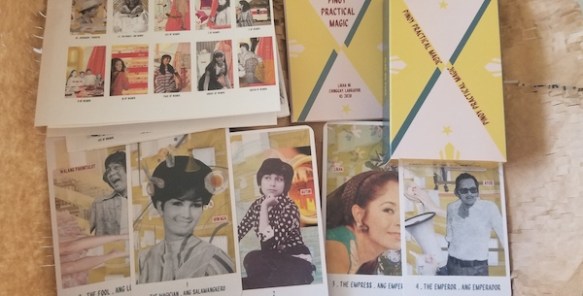
The Pinoy Practical Magic tarot is a collage-style deck that uses photos from 1970s showbiz magazines. I love the Philippine flag-inspired backs, the national anthem lyrics on the back, and I especially, absolutely love the Tagalog translations of the majors, and the Tagalog keywords on all the cards. As an example, the High Priestess card is called Babaylan and its keyword is “kutob.” And yes, tarot readers may know that the High Priestess card is all about intuition, but for a Tagalog speaker, the word “kutob” just hits different.
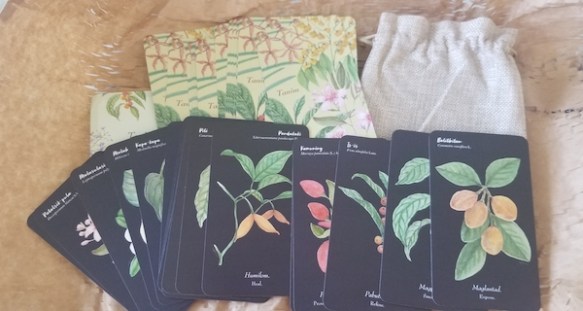
The Tanim Filipino botanical oracle deck features illustrations of plants in the Philippines and keywords in both Tagalog and English. I mostly love this deck because it’s making me nerd out over botanical information. It doesn’t come with a guidebook, so for people like me who know next to nothing about plants, you would need to look up the plants online. In reading with this, I usually read up on the plant, and then figure out how it aligns for me with the keyword on the card.
Language also plays a part in this. For example, the keyword for Philippine teak is “Manganib. Be wary.” The choice of “manganib” (which denotes danger) over the milder “mag-ingat” (take care) carries quite a bit of weight, and this nuance made me deep dive into what may be significant about Philippine teak. I also love the choice of “tanim” (to plant) rather than “halaman” (a plant) as the name of this oracle deck. It denotes an action, an invitation to plant whatever card you pull into your daily life.
Looping back to the Pinoy Practical Magic deck, I especially love how the keywords paint a vivid picture of the differences between the court cards.


Take for example the Queens:
- Queen of Wands: Bongga (not sure how to translate this… kinda like expressing yourself fully and openly)
- Queen of Swords: Magpakatotoo (be true to yourself)
- Queen of Pentacles: Aruga (care)
- Queen of Cups: Unawa (understanding)
Or the Kings:
- King of Wands: Astig (not sure how to translate this, TBH… kinda like cool? awesome?)
- King of Swords: Dunong (intelligence)
- King of Pentacles: Mamahala (the ruler)
- King of Cups: Pakisama (getting along)
For me, the Wands in the above examples are a great representation of why I love the Tagalog keywords so much. There are cultural nuances that don’t quite translate, and that add to the way we can read each card.


Other examples I love from the suits:
- 2 of Cups: M.U. (mutual understanding… a rather old-school term for a romantic couple who haven’t quite made it official yet)
- 3 of Cups: Barkada (a friend group, but also kinda more than that? More like your core friend group, maybe.)
- 6 of Cups: Senti (sentimental, again a Filipino colloquialism)
- 3 of Swords: Bigo (romantically rejected, and again, seeing the Tagalog word hits harder)
- 9 of Swords: Bangungot (nightmare, but more like the kind of nightmare that comes with sleep paralysis and can make you feel like you’re truly trapped and going to die)
- 3 of Pentacles: Bayanihan (a Filipino cultural practice where the entire community comes together to help each other out)
- 5 of Pentacles: Tamlay (no energy)…I find this an interesting choice for the 5 of Pentacles, which I’ve always associated with poverty. This particular card invites deeper reflection for me, and perhaps a deeper dive into all the potential meanings and nuances within 5 of Pentacles.
Even better, this tarot deck comes with a set of stickers you can use for journaling. Perfect for deep dive reflections into the readings!
 Literary Treats