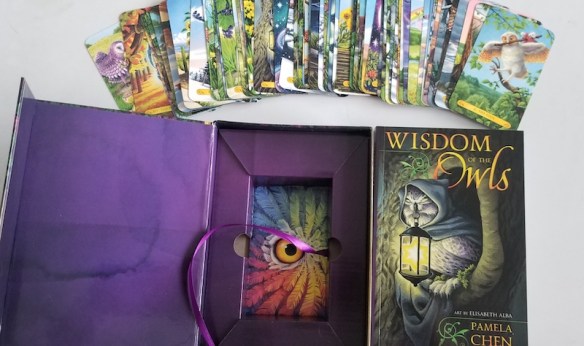
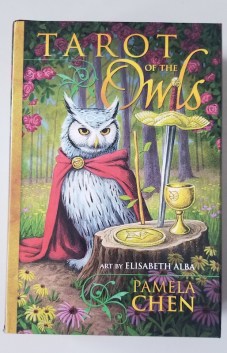
 Owls share their wisdom in this absolutely beautiful and evocative deck by Pamela Chen, with art by Elisabeth Alba. The box is lovely, the cards shuffle well, the guidebook has both upright and reversed meanings and spreads, and the artwork is just stunning.
I’ve never been particularly drawn to owls. My experience with them is mostly from Owl in the Disney Winnie-the-Pooh cartoons, and he’s always seemed a bit more fussy than wise. But I love how they’re associated with wisdom, how images of them can evoke calm and reflection, and how adorably derpy they can look. And from my first few flip throughs of this deck and guidebook, I can definitely see how this would be a deck I’d turn to when I want a bit of a quieter reading — not necessarily gentle, but rather the kind where I need to sink inwards and get in touch with my inner wisdom. It seems that kind of deck, and I look forward to working with it.
The Guidebook
It’s lovely. I like how it’s titled Wisdom of the Owls, and unlike the Magician on the cover, the guidebook cover features the Hermit, which reflects the spirit of contemplation I feel works really well with this deck.
The first couple of chapters are great introductions for folks who are new to tarot. Chen does a good job in explaining the way the deck is set up (it’s very much a Rider Waite Smith deck, and none of the cards or suits have been renamed). I also like how she explains the court cards, which in this guidebook are arranged by court rather than by suits, and how one must past through the trials of a Knight before becoming a King or Queen of that particular suit. Chen also offers some ideas on how to cleanse your deck before first use, and — which I love — how to interview your deck to get it know it better. (I include this deck interview at the bottom of the post.)
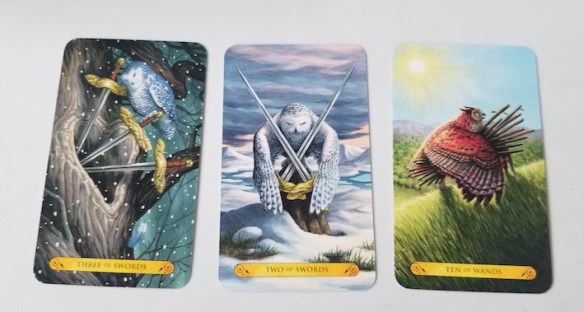
Each card gets a full colour page with an enlarged version of the artwork and upright and reversed meanings. The language is direct and clear; new tarot readers can get to know each card’s meaning, and more experienced readers will find info to enhance their own intuitive interpretations of the card. I especially like how Chen explains Three of Swords reversed. In this deck, the card features three swords embedded in a heart-shaped hole in a tree, while a blue-grey owl leans wearily against the trunk, a solitary feather fluttering to the ground. The guidebook states:
When the Three of Swords is flipped around, the piercing Swords will fall out of the heart-shaped hole. This representation of release is related to the pain leaving your heart. Memories and lingering feelings might still be there, but this is the first step into healing. With the end of your mourning period, you are starting the flight to your next adventure.
I love the visual of the swords falling out of the tree, and the exhausted little owl being ready to fly again.
There are also a number of spreads at the end of the book, including some ideas for one-card pulls, basic three-card spreads, and more complex multi-card spreads. I personally wish the prompts in the more complex spreads were more owl-themed, similar to how the Mystical Cats Tarot has the Nine Lives spread or the Shield of Sekhmet Spread, but otherwise, the spreads are pretty good.
The Cards
I’m a huge fan of Elisabeth Alba’s artwork. Her Everyday Witch tarot is my favourite go-to when I read for people I don’t know well, because her artwork is so clear and direct that even when I was just getting started with tarot, I could pick up on the gist of the card meanings even without a guidebook.
Here are some of my personal favourites from this deck:
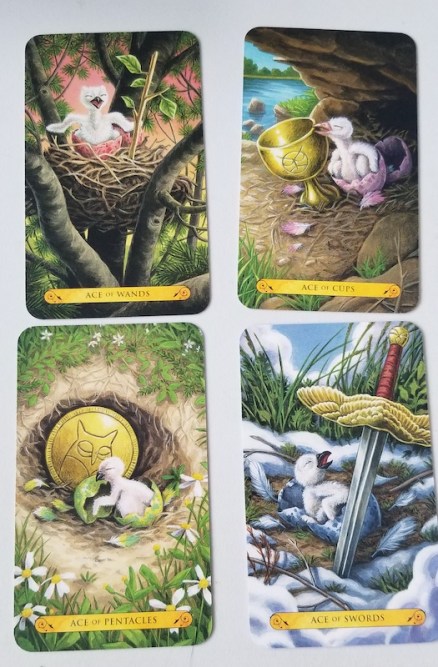
The Aces: I did not realize how much I need baby owls in my life until these cards, OMG!
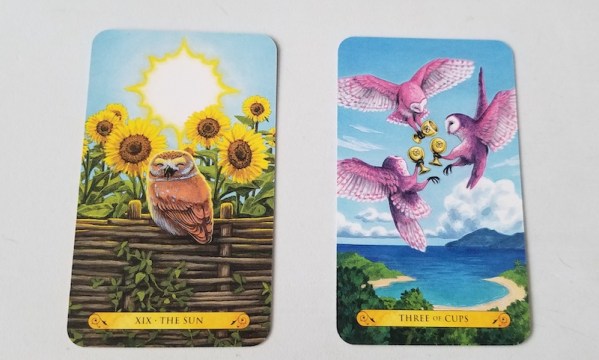
Cards that Evoke Joy: Just seeing these cards make me smile!
Cards that Deal with Tough Emotions: You can just feel the weariness of these owls. (On the left is the Three of Swords I mentioned earlier.) I also like the symbolism of the owl in the Ten of Wands carrying the wands in their wings; the image reminds us that unless they release those wands, they are unable to fly.
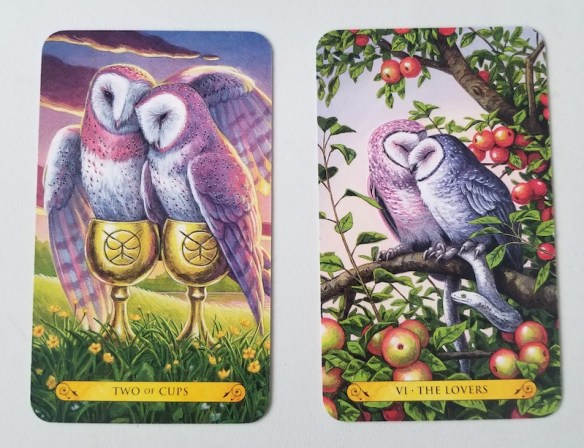
Cards that Evoke Love: I mean… awwwwww…. I also like how the colour palette for both pairs is pretty similar. It’s a nice visual call-out to each other.
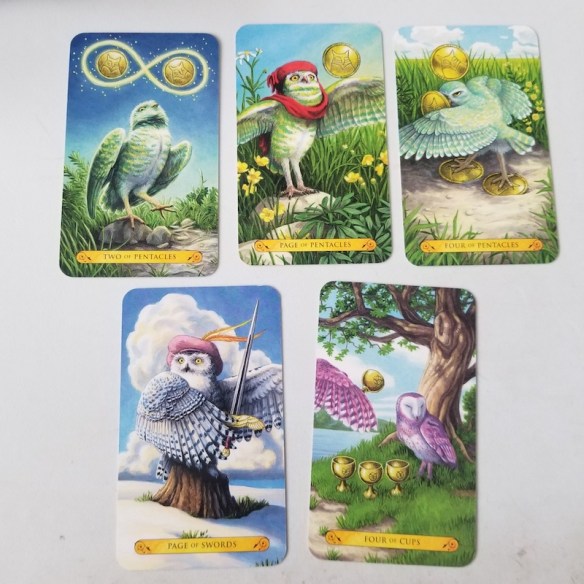
The Action Cards: How badass does the owl in Four of Pentacles look? How adorably earnest are the owls doing their thing in Two of Pentacles, Page of Pentacles, and Page of Swords?! And how potent is the visual in Four of Cups of the owl waving off the fourth cup being offered?
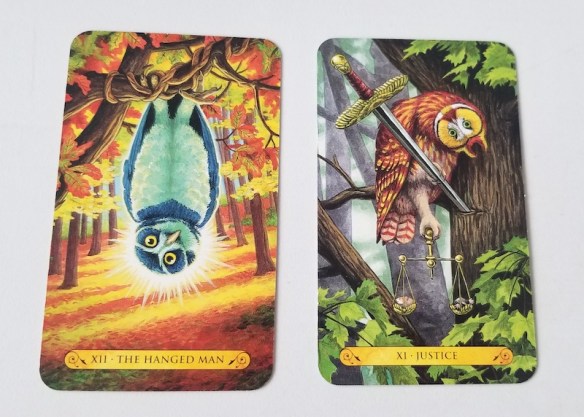
And, of course, my Derpy Faves: Derp! Also I love how the Justice card also features an owl taking a different perspective!
Deck Interview
The guidebook recommends cleansing the deck, looking through all the cards a few times to get a sense of the deck’s energy and seeing if any cards in particular resonate with you. Chen also recommends journaling about your responses to the deck; as someone who reads tarot primarily for personal journaling, I love this approach. Then she recommends three questions, which I’ve slightly adapted to be more general and I’ll list and answer them below. I recognize that each person engages with a tarot deck differently, so I’ll approach this deck interview with as broad a frame of mind as possible.
- What types of readings are best suited for this deck?
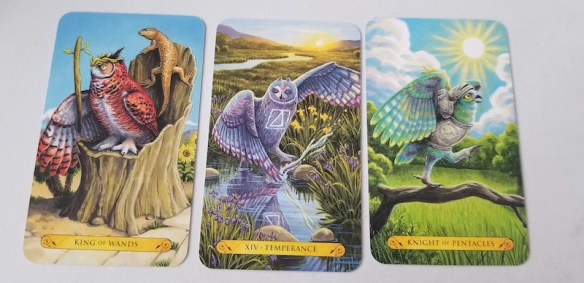
King of Wands
It seems this deck is best suited for moments when you’re already clear on your direction. You’ve gone through the learning journey of figuring out what your passion is, what inspires you and fires up your imagination. Now you’re ready and eager to level up and transform this passion into something you can share with others. You may just need a bit of guidance on how.
- How can readers best receive guidance from this deck?
Temperance
To me, this flows beautifully from the answer to the first question. When we want to share our passions with others, and possibly inspire others to pursue their own passions, we must still be mindful of managing our energies so we don’t burn out.
This deck seems well suited to helping us figure out how to strike that balance, so we may continue on our King of Wands journey in a sustainable way.
- How does this deck support readers on their current path?
Knight of Pentacles
While all four Knights are action-oriented, the Knight of Pentacles is the most grounded of the four. They’re the ones we can rely on to march steadily towards their goal, and be rational in how they manage obstacles along the way. I love that it’s the Knight of Pentacles that showed up for this, and not their more fiery and impulsive counterpart, the Knight of Wands. They’re a good counter-balance to the King of Wands energy with which we started this reading.
This tells me that the Tarot of the Owls has the potential to be a force for equilibrium. Reading with this deck helps us channel our King of Wands energy into a steady, reasonable, and ultimately productive action plan. At least from this reading, it may not be the deck we turn to when we need firing up, but it can help us manage our fiery emotions and see a clear path towards accomplishing our goals.
+
Thank you to Thomas Allen Ltd (Canadian distributor for Llewellyn) for a copy of this deck in exchange for an honest review.
 Inspired by
 Literary Treats