
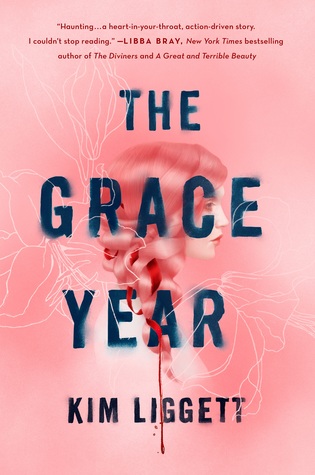
 Just when I thought I’ve already read any YA dystopia formula there could ever be, comes a book that just blows me away. The Grace Year is Handmaid’s Tale meets Hunger Games meets Mean Girls with a touch of Twilight, and it all comes together in a breathtaking way.
I love the touch of mysticism mixed in with hard reality. And I especially love the little touches of impending rebellion, signified by a flower, that lead to a wonderfully thrilling reveal about the usurper’s identity, and to an absolutely heartwarming revelation at the end. While most YA dystopias focus on the revolution, The Grace Year explores how the seeds for revolution are planted in the first place, and is all the stronger and more powerful for it.
The novel is about a tomboy named Tierney, who just turned 16 and is about to enter her grace year. Along with other 16 year old girls in her village, Tierney is off to live in the woods for a year, in order to ‘purify’ herself of all the magical powers in her system. The girls who return from their grace year are haunted by their experience, and some girls never return at all. And before they leave, the boys and men in their village decide each girl’s fate when they return — some will be selected for marriage, and the remainder will spend the rest of their lives doing hard labour.
The social commentary in this novel is not at all subtle, but I love how Liggett manages to weave in fairy tale elements with some horrific and downright criminal explanations. The girls are clearly victim to the larger forces of the society they live in, yet when separated from their home, some of them turn on others with the ferocity of people who know all too well how fleeting this taste of power will be. It’s both cruel and tragic, and even though queen bee mean girl Kiersten definitely goes far over the line in her quest for dominance, I still found myself feeling for her as the story unfolds.
Probably my favourite part of this book were the glimpses we got into the outskirts, where girls have been banished and a somewhat impoverished but free community has developed. I love how the rebel leader’s identity was revealed, and how it tied into the entire story overall.
There’s an unlikely romance as well, between Tierney and a hunter named Ryker. It was a Twilight-like predator and prey pairing that was sweet in some ways but also didn’t fully sit right with me. Partly, it’s because I prefer Michael, Tierney’s best friend who’s waiting for her back in the village, and by the end of the book, he does something that made me love him even more. But also partly because while the novel provides context for Ryker’s situation in a way that somehow makes us understand why he and others like him are hunting girls in their grace year, what the hunters do to the girls is just disturbing, and whatever Ryker’s situation, I couldn’t quite cheer him on. So I’m not sure how I feel about how this particular subplot turns out, but I do like how things are all tied together in the end.
Overall, The Grace Year is a thrilling and feminist dystopian. Its social commentary is fairly obvious, but its form of rebellion is surprisingly subtle. It ends not with a happy resolution, but rather with the promise of one, and one that won’t come till long after the story ends. Paradoxically, this offers an ending that in today’s world feels both more realistic and more hopeful at the same time. It acknowledges that evil doesn’t always live in particular despots, but rather in social systems that will take generations to overturn. And even if we don’t get to witness this overturning ourselves, we can at least be assured that it will come someday, and that we played a small but integral part in making it happen.
+
Thank you to Raincoast Books for an advance reading copy of this book in exchange for an honest review.
 Literary Treats