
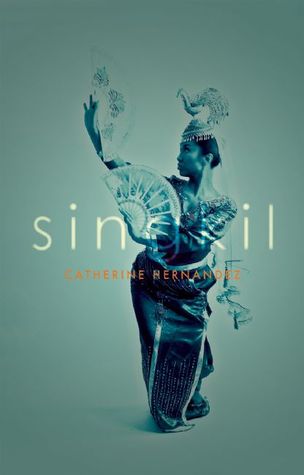
Review | Singkil, Catherine Hernandez

10351374The Singkil is a Filipino dance that tells the story of a Muslim Filipina princess who gets through a forest safely while the gods send a terrible earthquake to trip her up. It’s danced with fans and bamboo poles, and is an expression of grace delicately balanced within danger, as the dancers must step nimbly between moving bamboo poles that could trip them up or crush their ankles with a single mistake.

Catherine Hernandez’s play Singkil is a highly symbolic and evocative expression of this dance. It tells the story of Mimi Perez, a Filipino-Canadian woman coming to terms with her mother’s death. Her mother Maria used to dance the Singkil, but then gave up her dancing when she and her husband Nestor moved to Canada to build a new life for their family. Mimi has never learned the dance but somewhat auspiciously discovers her mother’s Singkil headdress in her apartment.

The play moves back and forth in time, showing Mimi dealing with boyfriend troubles and the complex emotions dredged up by her mother’s childhood friend and fellow dancer Norma coming for a visit, then flashing back to Maria and Nestor’s life in Manila and in their first few years in Canada. It’s a complex story, and Hernandez includes a lot of choreography stage directions that sound beautiful and evocative.

It sounds like a beautiful play and I think it’ll be incredible on stage, but it doesn’t quite translate as well onto the page. The fluidity of the time periods and shifting character roles felt confusing to read about, and the parts about the voices Mimi hears and the choreography the characters go through lose some of their power in book format. Still, I love the photos of the production included in the book, and I’d love to see the play — and the Singkil dance! — performed onstage.

+

Thank you to Playwrights Canada Press for a copy of this book in exchange for an honest review.

Review | Still Me (Me Before You # 3), Jojo Moyes

35791968OMG how much do I love this book?! Jojo Moyes has just taken me on an intense emotional roller coaster. Louisa Clark is as wonderful as always and if this gets turned into a movie, Emilia Clarke will be just perfect in it. In Still Me, Louisa Clark moves to New York to care for the much younger second wife of a wealthy businessman and gets drawn into their family and society drama. She is also dealing with the challenges of her long distance relationship with Sam, who has just been assigned a beautiful young partner at work, and then meets an American who looks unnervingly like Will Traynor
There are so many reasons this book was such fun to read, but mostly, it was the characters. What an incredible cast! I loved the glitzy glamorous world of the Gopniks, which started out hilarious then revealed itself to be much more complex than first glance.

I absolutely ADORED Mrs DeWitt and her beloved dog Dean Martin, and that was just the most heartwarming, heartbreaking part of the book. One scene near the end involving these characters made me ugly cry, and I just wanted to hug them all.
Nathan is awesome as always, and I’m so glad Louisa got to work with him again. I also love new characters Ashok and Meena, and their fight to save the community library. There’s also a great scene where Louisa sees Ashok in civilian clothes for the first time (he’s usually in his doorman uniform). She realizes how work uniforms can render you invisible, and wonders if their wealthy employers would notice them more if they weren’t wearing uniforms.

I also loved the bits about Louisa’s family, particularly about Treena’s new relationship and how much happier and more content she now is.

I also loved the storyline about Louisa’s relationship with Sam. There are some hilarious bits (food poisoning) and serious conversations about the challenges of maintaining a long-distance relationship. I also loved the way Moyes treated grand romantic gestures in this book. It started as a silly and fun concept that Sam did at an airport mostly to humour Louisa in the beginning of the story, then as their relationship progressed, he understood a bit better about the significance of such gestures. In a heartbreaking series of emails, he confesses he was never the type to do grand romance, and asked Louisa if that’s what she wanted and she responded that she never wanted anything grand from him at all. And finally, I won’t spoil the outcome of the final grand romantic gesture in the book, but I will say that while I scoffed at the idea at first, I was completely, at-the-edge-of-my-seat riveted during those final scenes. It was beautifully written and I was hooked throughout.

Most of all, I loved how Louisa really grew into herself in this book. She has always kicked ass, but here, with the help of Mrs. DeWitt, she comes to the understanding that she’s great at caring for others, but she can’t live for others, nor can she structure her life to suit others’ adventures. I love how her story turns out, and I can just imagine a vintage Devil Wears Prada type Book 4.

Still Me is of my two favourite books of 2018 so far (the other being The Wolf by Nate Blakeslee). I just wanted to keep losing myself in this story, and even when I had to stop reading for real-life stuff, I was excited by the thought that this book would be waiting for me on my next break or when I got home.

+

Thank you to Goodreads and Penguin Random House Canada for a copy of this book in exchange for an honest review.

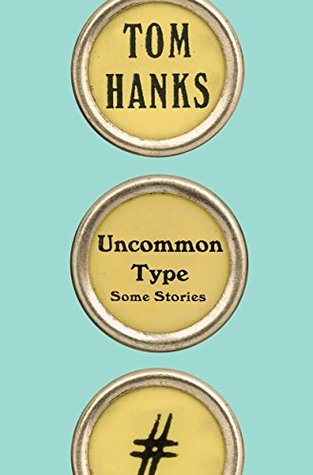
Review | Uncommon Type: Some Stories, Tom Hanks

34368390Tom Hanks’ short story collection Uncommon Type is much like his on-screen persona — warm, comforting, nostalgic. The stories, even the more sci-fi ones, harken back to simpler times, and the writing style reminds me a bit of classic lit.

Hanks’ strength as an actor is the humanity he brings to his roles, and similarly, the strength of these stories is the depth of the characters. On one hand, the characters feel ordinary, and not the real type of ordinary that socks you in the gut with their realness, but more like the extras in Hollywood movies. But there’s a glimpse of the emotions and experiences beneath the surface, and that it turn infuses the tales with a bit of a bittersweet tang.

My favourite stories:
– “The Past is Important to Us” a time traveller falls in love with a young woman he sees at the World Fair, but the time travel technology can only take him back to that same day and gives him a maximum of 22 hours before he has to return. The choice he makes at the end is bittersweet.
– “Steve Wong is Perfect” – a guy hits a streak of perfect strikes in bowling and gains fame and fortune but loses the joy in playing. I love how Hanks depicts Steve’s gradual emotional decline.
– “Go See Costas” — a Bulgarian immigrant survives violence back home and struggles to find a job in America. The final scene is powerful.
– “A Special Weekend” — a young boy is treated to a weekend at a hotel and then a plane ride with his mom and her boyfriend — Hanks is coy about the role of this man in the mom’s life, realistically reflecting the perception of his child narrator who’s mostly excited about the plane
– “Three Exhausting Weeks” – a pair of best friends, one a health and exercise nut and the other a couch potato, hook up and their romance leads to the couch potato guy wondering if he can keep up with his girlfriend’s lifestyle. I found this funny and relatable, and I especially love the side characters MDash and Steve Wong, and the subplot about MDash’s citizenship ceremony.

I also really liked the stories “A Junket in the City of Light” and “Who’s Who?” because they both give a glimpse into the life of an actor. “Junket” does a great job in portraying how exhausting press tours can be when promoting a film, and in this story, the lead character has to face the harsh reality that it’s really his co-star the press cares about and not him. In “Who’s Who?” an agent tells a beginner actress she basically has to reinvent herself (change her name, change the way she presents her high school theatre experience) to land a job. When she tells him that she’s afraid changing her name will disappoint her parents, he responds, “Disappointing your parents is the first thing to do when you come to New York.”

Typewriter buffs and people who love shopping in independent stores will love “”These Are the Meditations of My Heart.” A woman takes a cheap typewriter in for repair and instead discovers the perfect state of the art typewriter for what she needs. When the shopkeeper asks her why she wanted that particular machine, she says:

“I just want to set down what few truths I’ve come to know. […] I want my yet-to-be-conceived children to someday read the meditations of my heart. I will have personally stamped them into the fibers of page upon page, real stream-of-consciousness stuff that I will keep in a shoe box until my kids are old enough to both read and ponder the human condition!” she heard herself shouting. “They will pass the pages back and forth between them and say, ‘So that’s what Mom was doing making all that noise with all that typing,’ and I am sorry! I’m yelling!”

“Ah,” he said.

“Why am I yelling?”

The old man blinked at the young lady. “You are seeking permanence.” [pp. 234-235]

Hanks is very public about his own love of typewriters, and he has a whole collection of them. I can imagine him yelling as the young lady in this story does, and pounding away at the eyes to tell the stories in this book. It’s a heartwarming image, and as a Tom Hanks fan, I’m glad I got to pass time with these pages of truths he’s come to know.

+

Thank you to Penguin Random House Canada for a copy of this book in exchange for an honest review.