
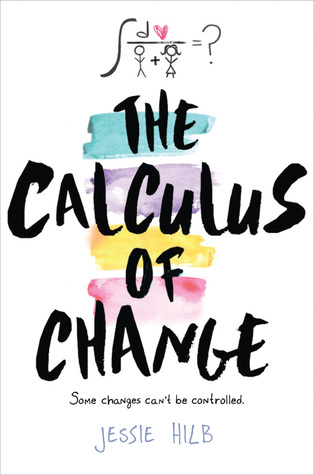
Review | The Calculus of Change, Jessie Hilb

31286355The Calculus of Change is such a sweet and moving piece of realistic YA fiction. It begins as a story of unrequited love — Aden is secretly in love with her classmate and friend Tate, whom she tutors in Calculus and who already has a girlfriend — and I requested it for review originally because I love the friends-turned-lovers and the shy-girl-gets-the-guy-in-the-end tropes. But the story reveals itself fairly early on as being much more than a romance; there’s almost a Judy Blume feel in the texture of its realism and in the themes it tackles about family, friendship and spirituality.

Much of the story actually centres on family issues and coming to terms with grief. Aden, her brother Jon and their father have a somewhat strained relationship, partly because the father has a hair-trigger temper than keeps his children on edge even though he never quite gets physically violent. Early in the book, he jokes about being like a teenager himself in his mood swings, and I love how Hilb keeps the tension thrumming just beneath the surface in that scene — we know it’s a lame out for his immaturity, but we can also understand why Aden would let it pass. As the story progresses, however, we see that a lot of the strain also has to do with the family’s struggle to get over the death of Aden and Jon’s mother, an event they all just kinda deal with, but never actually worked out in depth as a family. Scenes where Aden’s father watches her playing her mother’s guitar or gives her lyrics her mother has written are beautifully heart-wrenching in the subtlety of their execution.

Moreover, Aden’s attraction to Tate in the first place is somewhat linked to her missing her mother: she notices him for the yarmulke he always wears. While Aden’s family isn’t very spiritual, her mother was Jewish, and her earlier conversations with Tate are about Judaism and their shared heritage. While their friendship later expands beyond spirituality, I love how this romance is more than the usual hot-guy-heartthrob, and how her feelings for Tate are somewhat interwoven with her desire to know her mother better.

I also like the way the romance and somewhat love triangle feel real. Often, Tate’s girlfriend Maggie would be portrayed as a popular mean girl, but Hilb instead chooses to make her likeable. She was so likeable that even though I knew I was supposed to be rooting for Aden and Tate to get together, I couldn’t help but root for Maggie to keep Tate instead, since they actually seemed good together. I particularly love how self-aware Hilb makes Aden, such that even when she lashes out at Maggie, she knows Maggie didn’t actually do anything to deserve it. In one of my favourite parts, Aden reflects on how easy it would be to frame the love triangle as a Taylor Swift song, with Aden as the girl next door and Maggie as the bitchy cheerleader, but the truth is that there’s a bit of both personalities in both of them.

There are so many other subplots that round out these characters and make them feel so real, including body image issues (Aden is insecure next to thinner and prettier girls like Maggie and Aden’s best friend Marissa), sexual assault, sex with regrets, sex with consequences, and so on. I was particularly moved by the subplot that explored romantic power dynamics — Marissa is in a relationship with her English teacher (who is married with children) and is seriously considering having sex with him. I love how realistically this plays out (until possibly the very end which seems a bit too easy), with Aden struggling between wanting to report the relationship as inappropriate but not wanting to hurt Marissa.

There’s also a very well written subplot about financial barriers in Aden and Jon’s family, with both teens wanting to go to prestigious colleges but not having enough money to afford both. Jon’s dilemma of going to his dream school for his dream program or going to a college where he may have a shot at a sports scholarship is very relatable, as is Aden’s being torn between supporting her brother and wishing he chooses the scholarship to increase her chances of her father being able to send her to her dream school.

My one (admittedly slight and possibly unjust) disappointment is that there wasn’t a lot of calculus in the story. I was expecting a wonderfully geeky romance like When Dimple Met Rishi, yet there was very little geekiness in the story.

Beautifully written and compellingly told, this is a powerful, moving story with so much packed inside. I loved it.

+

Thank you to Raincoast Books for an advanced reading copy in exchange for an honest review.
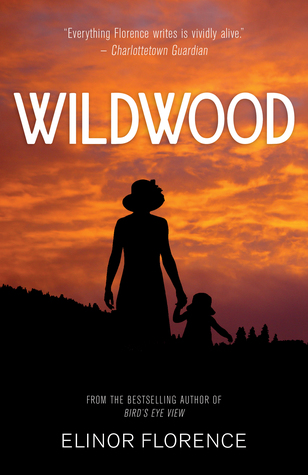
Review | Wildwood, Elinor Florence

34878639Wildwood is a contemporary pioneer narrative, Susanna Moodie’s Roughing it in the Bush updated to the 21st century. It tells the story of Molly, a young single mother who must live in a remote farm in northern Alberta for a year to receive her great-aunt’s inheritance. Far from civilization, the farm has no electricity or running water, and Molly must rely on her wits to survive. To complicate matters, Molly is also from Arizona, and ill-prepared for life in place where winter lasts nine months. Her main motivation is the $1.5 million she stands to inherit if she lasts a year — broke and jobless, Molly desperately needs the money to pay for her four-year-old daughter’s medical treatments.

I absolutely loved this book. Early in the story, Molly muses that she worries about urban dangers like criminals and traffic accidents, but never seriously considered until now that nature herself would be a threat. That pretty much sums up the book: it’s the classic Canadian literature trope of settlers struggling to tame the wilderness, and Florence does a great job of making it believable in the present day. I enjoyed reading about Molly and her daughter Bridget’s adventures in figuring out how to get water from the well and how to use the outdoors outhouse as a toilet. I like how practical Molly had to become in her choices, whether it’s deciding what groceries are absolutely necessary for that month or choosing to get a cat to deal with the mice in the basement. Moreover, I loved the characters, from 12 year old Wynona, an Indigenous girl from a nearby reservation to bubbly and friendly Lottie, a lawyer’s assistant who dresses in retro funk and is not-so-secretly in love with her boss.

I’m not too familiar with selective mutism, which is what a child psychologist diagnosed Bridget with, but I like how Elinor Florence presents the challenges Molly and Bridget face when encountering new people who sometimes don’t understand Bridget’s boundaries. I also love seeing Bridget flourish in the solitude and calm of the farm, and slowly become more comfortable being around other people.

There’s also intriguing plot threads about untrustworthy authority figures, that are dealt with mostly in passing, and an insta-love romance that sparks without ever actually sizzling. These feel mostly like distractions and while their impact can be significant, the story doesn’t quite dwell on them enough to detract from the overall pleasant feel of reading this book. There’s also a secondary parallel story of Molly’s great-aunt, told through her journal, but while there are some touching moments in this, it never quite becomes as compelling as Molly’s story.

At one point, Molly admits she doesn’t miss having a phone or TV to learn about world news, like people getting killed or a cafe being bombed, and indeed there’s something escapist about immersing oneself in this story. Despite the pioneer-like struggles, there’s a retreat-like calm in isolating one’s focus to the bucolic problems in this town, and a comfort in the friendly warmth of Molly’s neighbours. I would definitely not call the pioneer era a simpler time, but the story does hearken to an appealing simplicity, and Wildwood is a fun read for a chilly weekend in.

+

Thank you to Dundurn Press for an advance reading copy of this book in exchange for an honest review.

Review | American Panda, Gloria Chao

35297380American Panda is the YA book I wish I could’ve read when I was a teen. I loved and related to Mei so much as a character, and it was such a wonderful, emotional journey to see her deal with her parents’ expectations, her brother’s estrangement from the family, and her crush on her classmate Darren Takahashi.

Mei is a 17 year old second generation Taiwanese American girl in her first year at MIT, and all her parents want for her is to become a doctor, marry a nice Taiwanese boy and, in order to attract the nice Taiwanese boy, lose some weight. As her mother not-so-kindly puts it, Mei is somewhat like a panda, when she really should become more like a cat to attract boys. Another problem is that Mei hates germs and is bored to death in biology class, so the idea of medical school is her worst nightmare, never mind actually becoming a full-fledged doctor. She much prefers to dance, which her parents let her study as a child to help her lose weight, but which she now pursues in secret. Mei is all too aware of the potential consequences of disobeying her parents — her older brother Xing was disowned by the family when he got engaged to someone they didn’t approve of. When Mei secretly reconnects with Xing, she begins to wonder if being such a good daughter is even worth it, if it means giving up her chance at the life she actually wants.

How much do I love this book? There’s so much I love about it, but I think what really resonated with me the most was Mei’s relationship with her mother and brother. Despite some pretty callous comments, Mei’s mother isn’t a cruel person, but rather someone trapped within many of the same social constructs she in turn tries to impose on Mei. Her mother is from a generation and a culture that privileges traditional family roles, which includes respect (read: obedience) for elders and for the man’s position as head of the family. As the story progresses and we, along with Mei, get to know her mother better, we realize how much of what she says may not necessarily be what she feels, but rather what she has been taught as the right thing to feel. Chao’s brilliance as a writer is perhaps most evident in the character of Mei’s mother, as the woman we initially see to be the most insurmountable barrier to Mei’s freedom turns out to be one of, if not the, most sympathetic characters in the novel. Put simply, I’d read an entire novel from her perspective, as even after finishing American Panda, I find myself still so fascinated by all the layers in this character that have yet to be peeled away.

Mei’s relationship with her brother is another extremely strong feature of the story, as I loved seeing the contrast between the lives both were living. I also loved seeing the tension both siblings feel, as they want the freedom to live the life they choose, but at the same time, can’t escape the strong ties to their family. Xing’s detachment from their parents was clearly not his preference, and even though he and his wife were treated very badly, he still clearly feels a connection to the family. I love this relationship because it puts into context the terrible extent of the dilemma facing Mei. Would it be worse to never be able to speak to your parents again, or to have to put up with a career you hate for the rest of your life? Her dilemma felt distinctly Asian American, both aspects of her culture warring for dominance, and that’s a hell of a burden for a 17 year old girl.

I also liked the realness of the body image part of the story. Mei’s family often comments on the food she eats, and how she really should refrain from a second helping of rice, and I don’t know if it’s an Asian family thing or a family thing in general, but the dialogue felt so completely familiar. Also in another scene, a cab driver tells Mei she can’t be Chinese, because she’s too chubby to be Chinese, and for anyone who thinks that level of rudeness is unrealistic, let me tell you: it happens, and I love Gloria Chao for writing about it. Most of all, I love that Mei never develops an eating disorder nor does she obsess over her weight beyond being understandably uncomfortable by what people say. In this, Mei is both relatable and aspirational.

Finally, the romance with Darren was a minor subplot compared to the family drama, but I loved it anyway. I thought their flirtation was adorable, and I have to admit, I got all kilig in that scene where Darren takes her to a spot in MIT where a pair of walls make the sunset particularly incredible.

I simply adored this book and its cover art, and I absolutely loved Mei. American Panda is such a treat from start to finish, and I highly recommend reading it with a cup of hot cocoa with whipped cream.

+

Thank you to Simon and Schuster Canada for an advance reading copy in exchange for an honest review.