
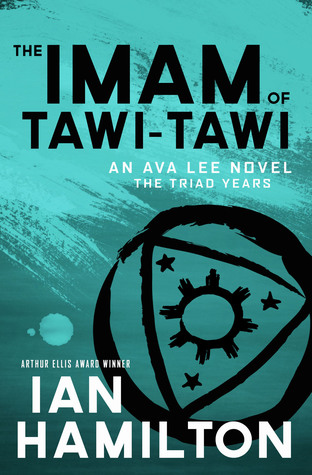
Review | The Imam of Tawi-Tawi (Ava Lee 10), Ian Hamilton

34326164I’m a long-time fan of the Ava Lee books, and am thrilled to see this newest title is set in the Philippines. An old friend of Uncle’s calls Ava to request a personal favour — his friend Senator Miguel Ramirez fears that a college in southern Philippines is actually a training ground for terrorists, and he’d like Ava to investigate.

Imam of Tawi-Tawi is probably one of my favourite Ava Lee mysteries. I’ve never really been much of a fan of her superhuman fighting ability, and action movie fight scenes, and my favourite stories have always been where her humanity and vulnerability are allowed to show. So I absolutely loved the cerebral nature of this novel’s plot. There’s some action near the end, but mostly, it’s a very thorough investigation of paperwork and files, and there’s a lot of strategizing about how to get the answers she needs.

There’s also a lot of questions raised about justice, prejudice and the struggles faced by Muslims. While Hamilton doesn’t delve too deep into the complex history of Islam in the pre-dominantly Catholic Philippines, nor about the currently charged political climate of the country, he does touch on the subject. His characters note that the conservative Christian President of the Philippines would be likely to come down hard on the college at even the slightest suspicion of terrorist activity, and the actions of the American and Canadian intelligence officers who work with Ava show little regard for the students and staff at the college. The big reveal of the mastermind and motivation behind the events calls to question the assumptions the characters and we as readers have made throughout the story, and the response of various characters to this reveal is sadly all too realistic.

Imam of Tawi Tawi is an engaging and compelling mystery. Ava is forced to come to some tough decisions, and her choices, as well as the reasoning behind them, are a huge part of what makes her such a compelling character and what makes these mysteries such fun to read.

+

Thank you to House of Anansi for an advance reading copy of this book in exchange for an honest review.

Review | The Missing Guests of the Magic Grove Hotel, David Casarett

34123531The Ethical Chiang Mai Detective Agency is such a lovely series, beautifully written and an utter delight to read. Author David Casarett is also a doctor, and I love that while his books have some medical detail in them, the stories are much more interested in the ethical and moral conundrums around medicine than they are in the hard science. As a result, the Ladarat Patalung mysteries are a much-welcome softer form of medical drama, where the mystery isn’t so much about what happened as it is about how should we respond to what we learn has happened.

In my review of the first book, I write about how Ladarat’s empathy is a vastly underrated super-skill in detective fiction, and while it’s back in full-force in The Missing Guests of the Magic Grove Hotel, it’s more her power of observation that gets the spotlight. The main mystery in this instalment is about the mysterious disappearances of wealthy foreign travellers after they check in to the Magic Grove Hotel. The truth and the motivations behind it are a fairly easy puzzle to solve, and to be honest, I was a bit frustrated that Ladarat’s talented detective boyfriend Wiriya took so long to figure it out. Still, the strength of this particular puzzle lies in the questions it raises after being solved. Casarett does a great job in delving into the emotions of the characters involved, and I ultimately found it a very moving, somewhat disquieting story.

As with the first book, Ladarat also had to deal with a cluster of subplot mysteries — a smuggling ring with operatives identified by their parrot bags, bus passengers falling asleep and getting robbed, a doctor whose performance is slipping for no apparent reason, and an oddly low mortality rate in the palliative care wing at Ladarat’s hospital. I loved these subplots because they fleshed out the world around Ladarat and gave some of the secondary characters a chance to shine. In particular, Ladarat’s assistant Sisithorn emerged as a budding detective herself, and I absolutely loved the enthusiasm with which she tackled both her job and her investigations, as well as the bemused yet also somewhat maternal mentorship Ladarat clearly feels for her. The reveals to these mysteries range from methodical to amusing, and the connection of one of the subplots to the larger case is moving.

Ultimately, the heart of this story goes beyond the mysteries and boils down to a question Ladarat ponders in her job as nurse ethicist — what makes for a ‘good death’, and what role should nurses and doctors play in helping people achieve that? The sobering nature of this dilemma is wonderfully balanced out by the lighthearted way in which Casarett treats the rest of his story. I love the delicious descriptions of Thai cuisine and the sweet hilarity of Ladarat learning to cook for Wiriya. I’m less a fan of Wiriya’s dismissiveness of Ladarat’s investigative insight, but I’m glad he realizes his error later in the book, and Casarett’s depiction of how Ladarat navigates the mansplaining in her world is all too relatable.

Magic Grove Hotel is a wonderful addition to the Ladarat Patalung series. The mysteries aren’t quite as puzzling as in Rooster Happiness, but the cast of characters is given more room to develop, and the series is all the richer for it. I’m a big fan of this series, and can’t wait for the next book!

+

Thank you to Hachette Book Group Canada for an advance reading copy in exchange for an honest review.

Review | Dangerous Crossing, Rachel Rhys

35297388As the book begins, a woman in fur is being escorted off a cruise ship by a pair of police officers. A journalist runs up to them and demands details on a crime that occurred. The journalist also inadvertently lets slip that Hitler has invaded Poland and the world is now at war, and the woman absorbs the news as the chapter fades to a close.

Flash back five weeks in time to the cruise ship setting sail from Britan, and young Lily Shepherd coming on board to take a job as a domestic servant in Australia. On the ship with her are her cabinmates Amanda and Ida, Jewish refugee Maria, handsome aspiring lawyer Edward and his sister Helena, wealthy couple Eliza and Max, and fascist jerk George. We don’t know whom among them is the woman in handcuffs, nor whom among them will be the victim, yet as the story unfolds, clear currents of tension arise amongst the characters.

The first chapter sets the tone of a golden age mystery, and indeed there’s a very Agatha Christie-esque feel to the novel that I loved. But expecting a Christie-esque mystery will only leave the reader disappointed. The murder itself doesn’t occur till late in the book and, despite the growing conflicts between the various characters, there is little of that escalating ominous undercurrent that makes Christie’s books so electrifying. As a mystery or thriller, it feels slow, and I found myself wondering when something would happen.

Rather, Dangerous Crossing succeeds primarily if you come to it with no expectations of a compelling mystery. The characters each have their own secrets to bear, but the individual secrets that are revealed — and that do play a part in the development and execution of the crime — aren’t quite as compelling as simply seeing the characters interact. Rhys does a fantastic job developing the world of 1939 Europe. As with the movie Titanic, one of the most compelling things about large ships is the stratification of classes among the passengers, and Rhys plays with that tension masterfully. The way Lily and Edward are somewhat ‘adopted’ as friends by Eliza and Max feels very much like rich children discovering new toys, and even seemingly generous acts like paying for their trip to Egypt or giving Lily a dress feel wrong for some reason.

Rhys also does a great job in conflating the immediate and personal events onboard the ship with the larger context of world events. Our awareness of the impending crime is compounded by our awareness of the impending war, and both colour the way in which we view the characters gaily exploring pyramids and shopping for souvenirs. The character of Maria is a particularly strong example of this, as she faces discrimination from fellow passengers, dismissiveness from the ship’s crew over her requests, and also lives with constant worry about the lack of news from her family back home.

Overall, Dangerous Crossing is a compelling and beautifully written novel, and fans of historical fiction will appreciate how thoroughly Rhys has crafted her world.

+

Thank you to Simon and Schuster Canada for an advance reading copy in exchange for an honest review.