
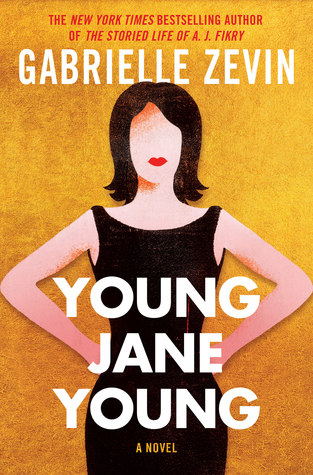
 I absolutely loved this book. An ambitious young Congressional intern Aviva Grossman has an affair with her married boss. Like Monica Lewinsky, she is eventually found out and vilified by the public as the Congressman’s team rapidly launches into damage control PR. Aviva’s reputation suffers from the fallout, and she finds herself unable to land a job in either politics or communications. Fast forward a few years, and Aviva has reinvented herself as Jane Young, a wedding and events planner in small town Maine raising her daughter Ruby. This is where the novel begins.
Young Jane Young is told in multiple perspectives. I absolutely loved the first section, told by Aviva’s mom Rachel, who longs to reestablish a relationship with her estranged daughter. I thought her voice was the strongest of the sections, and while the other sections of the book eventually intersect and reconnect with Rachel, I still wish we had gotten a chance to revisit her story and her perspective later on. She had been a vocal opponent of Aviva’s relationship from the beginning, yet looking back, she realizes that her aggressive, overprotective response may not have been what Aviva needed. Her regret is palpable, as is her fierce love for her daughter, and for the longest time, I shared in her resentment for Aviva, at not listening to her mother and making such stupid decisions.
Jane’s section is next, and while the story itself — about a wedding she has to plan for a sweet and meek woman and an overbearing politician — is interesting, her voice didn’t grab me as immediately as Rachel’s did. There was also an annoying coyness at the beginning about Jane actually being Aviva, which I thought was unnecessary, given that this reveal is already made on the back cover and Goodreads summary. Still, this section sets the groundwork for what happens afterward, which is well worth the set up.
The bulk of the action in the novel takes place over the next two sections when Jane decides to run for mayor of her town and her daughter Ruby runs away from home to track down the man she believes is her father. Ruby’s precociousness and independence strain credulity, but I actually liked her character and especially her emails to her pen pal in Indonesia.
My main sympathy for these sections of the book lie mostly with Embeth, the congressman’s wife who is surviving cancer, supporting his reelection campaign, and surprised to learn that after all this time, she is still expected deal with a scandal she’d thought long buried in his past. I’m so glad we got a section from her perspective, and that we got to see her humanity, as people around her don’t often see past the cool facade. She definitely deserves much better than the Congressman and I hope her story after the events in this book leads her to some form of happily ever after.
I thought Zevin handled these sections well. Ruby’s running away is a melodramatic act, yet Zevin’s treatment of the story and the multiple perspectives keeps the characters grounded and their emotions real. I also like how each section keeps a tight focus on its own perspective, so that even when other characters re-enter the picture, we are privy only to what the narrator sees. For example, Rachel appears in Embeth’s section during the whole drama over Ruby’s running away, but we don’t really get a sense of how her presence at this time impacts her relationship with her daughter or granddaughter. While part of me wanted to know more, another part acknowledges that Embeth would likely not be involved at all in that, so her perspective has a different focus.
The final section takes us back in time and reliving Aviva’s affair through a Choose Your Own Adventure. Part of me thought this format was a bit cutesy, but I also like how it framed Aviva’s affair as a series of bad choices, and filtered through a more mature, knowing perspective that understood how alternative choices (e.g. leave the room instead of pulling the congressman in for a kiss) may have been better options.
Overall, I highly recommend Young Jane Young. Some sections are stronger than others and some plot threads are frustratingly left unresolved, but I liked seeing how a youthful mistake can lead to some long-lasting consequences for many people beyond just the individual. I also liked the realistic depiction of power dynamics (the Congressman is a dick for taking advantage of Aviva like that) and the unfairness of gender disparity (Aviva being labelled a slut and unable to escape this label). I remember growing up in the Clinton era. Then and now, I firmly sympathize with Hillary Clinton, who has faced the public fallout from the affair even longer than Bill has, which I think is ridiculously unfair. But looking back, I also realize now how unjustly I viewed Monica Lewinsky, and reading this book prompted me to think about what she must have gone through.
+
Thank you to Penguin Random House Canada for an advance reading copy of this book in exchange for an honest review.
 Twelve year old Daisy Tanenbaum is sent to live in Paris with her cool code breaker aunt, and gets embroiled in a spy caper involving the Queen’s Diamonds.
 Literary Treats