
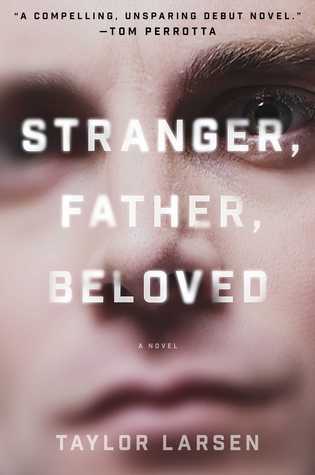
Review | Stranger, Father, Beloved, Taylor Larsen

27274351When Michael sees his wife Nancy chatting with a stranger at a party, his intuition tells him this is the man she should have married. What follows is a rather melancholy glimpse into the breakdown of a family, as Michael befriends the man, John, and schemes to have his wife fall in love and marry him. A concurrent storyline involves Michael and Nancy’s daughter Ryan who senses the marital tension and distances herself from her family, whilst, as the book blurb puts it, she “goes through a period of sexual awakening.”

It’s an interesting premise — how tragic is it to feel that you just met the man you know your wife should have married? Yet on the flip side, how fucked up is it to try to manipulate her into falling in love with this man enough to leave you, instead of just talking to her straight out? I’d expected Michael to be a bit of a tragic figure and to an extent he is, but he is also really messed up, like a reverse Tom Ripley who is determined to ensure himself a miserable life.

I mostly felt bad for Nancy. At one point, she says that while other women fantasize about sex with handsome strangers, her fantasy is for her husband to make love to her. How sad is that? She does deserve a more loving, affectionate spouse, and so to that end, kudos to Michael, I guess, for trying to make it happen?


Despite the story being told in Michael’s voice, it’s really hard to get into his head because all I could think of was how he was messing up the lives of people around him. At one point, he lets John believe he wants to leave Nancy because he has a serious, likely fatal, illness. I’m just imagining how scary and horrific it feels to learn that a loved one, whether a spouse or a friend, is fatally ill, and I’m actually angry at him for putting them through that. He later writes Nancy that he’s “sick in more ways than you know” and while he may have some medical conditions, I think he’s referring to something else which has a long, unfortunate history of being pathologized, and so that just made me like him even less.

It took me a while to get into this story and I almost didn’t finish it, but I’m glad I did because the story comes together in the end. Some of the things that really annoyed me came at the end as well, but overall, the ending made sense. There’s a quiet intensity to Larsen’s writing that I think will draw some readers in and at least propelled me enough to finish the book. It’s the kind of book that I think readers will either love and praise for its “mesmerizing, unsparing quality” (back cover blurb from author Karen Russell), or dislike and possibly hate for probably the same reason, its intensely claustrophobic focus on a man who self-destructs and takes his family down with him.

+

Thank you to Simon and Schuster Canada for an advance reading copy of this book in exchange for an honest review.

Review | Vinegar Girl, Anne Tyler (Hogarth Shakespeare 3)

27070127It must be a challenge to adapt Shakespeare’s Taming of the Shrew for a contemporary audience. Whereas Shakespeare’s audience presumably may have found Kate’s eventual capitulation comedic, today’s audiences may rightly point out the problem with a happy ending that features a woman submitting to a man.
The 90s movie 10 Things I Hate About You managed this well, I think, by blunting the force of Kat’s capitulation. While she still does succumb to a romance with Patrick, she does so only after he serenades her in style. (Still one of the best rom com grand gestures ever, and yes, clearly I have strong feelings about this too.)

In Vinegar GirlAnne Tyler updates the Shakespeare classic in two ways: she blunts the force of Kate’s “shrew”-ishness by making her a modern woman dissatisfied with her life, and she provides a more contemporary rationale for Pyotr’s need to date her. I have mixed feelings about both, though overall I think she pulled them off well.

Despite the title, there is little acerbic about Kate’s character. She’s blunt, particularly when speaking with her students, but in a way that feels more thoughtless than pointed, and she’s more disgruntled and grouchy than acidic. To be fair, she had plenty of reason to be grouchy. She’s stuck with a job she’s not sure is right for her, and she’s also stuck parenting her vapid younger sister and clueless scientist father. It’s no wonder her many responsibilities and lack of progress make her frustrated.

Tyler adds an interesting twist to the need to pair Kate off. Rather than the dated idea of the older sister needing to marry before the younger sister can have her shot, Tyler adds in a subplot about US immigration. Pyotr is the best lab assistant Kate’s father has ever had, so when his visa is about to expire, Kate’s father is so desperate to keep him that he schemes to marry him off to Kate so he can get a green card.


This is one instance where I wish Tyler’s approach had a bit more of an edge. There are so many complicated issues around immigration that I had hoped for a bit more skewering of a system that can force people like Pyotr to feel they have no choice but to commit such a desperate act as marriage simply their livelihood. Alternatively, I had hoped for a bit of satire around Kate’s father’s sense of entitlement, and his blindness to his own privilege. He’s basically pimping his daughter out to keep a lab assistant, and not enough characters call him out for it. Also, when so many people are so desperate to immigrate to the US for a whole range of reasons, Kate’s father’s cavalier attitude towards the process and utter confidence he would succeed is beyond clueless, and I wish Tyler had delved more into that, possibly by delving deeper into Pyotr’s emotions. There is a scene where Pyotr talks about missing home, which is possibly the point where I most liked Pyotr, and I wish we’d seen more of that.

As well, putting that kind of pressure on Kate is kind of a dick move by her father, and his logic that she shouldn’t mind because she had no romantic prospects otherwise made me wish Kate had a bit more of Julia Stiles’ fire from 10 Things. I realize she eventually made a decision on her own terms, and to an extent, I’m gleeful at how she out-smarted her father in one very significant way, but overall, I felt kind of bad for her. Her actions felt more born out of hurt feelings than a victorious assertion of self, and I just wanted to look her father and her relatives in the eye and ask them what the hell they’re thinking, treating Kate that way.

A lot of my ambivalence about the ending, I think, is because Kate and Pyotr’s relationship felt oddly emotionally detached to me. Pyotr’s a bit of an opaque character so it’s hard to know how he feels about Kate — he says random things that for the most part seems pleasant and friendly at most, but shows more passion for home and the mice in the lab than for Kate. They barely seemed more than acquaintances throughout and any potential for marriage had all the passion of a roommate arrangement. In contrast, there seemed more chemistry with a cute co-worker that Kate had her eye on, and I only wish he had a bigger role. Where is the chemistry from 10 Things or even the fiery passion from the battle of wits in Shakespeare’s original?


All that being said, one spot where I’m glad for Tyler’s gentle hand is Kate’s final monologue, which in Shakespeare’s original, raises my hackles:

[…] dart not scornful glances from those eyes
To wound thy lord, thy king, thy governor.
It blots thy beauty[…]

Thy husband is thy lord, thy life, thy keeper,
Thy head, thy sovereign[…]

I am ashamed that women are so simple
To offer war where they should kneel for peace,
Or seek for rule, supremacy, and sway,
Whey they are bound to serve, love, and obey.

Taming of the Shrew, V.ii.2645-2670.

Tyler completely revamps this monologue into a treatise about the unfairness of gender roles and an acknowledgement of the pressures men feel to be stoic and strong. The speech felt a bit out of place within the novel, and Kate’s bringing it up felt a bit random, but I thought it struck a good balance between the level of capitulation Shakespeare’s original provided and a more modern sensibility around gender norms.

Overall, Vinegar Girl is a quick and light read. I’m not completely sure how I feel about it, but I enjoyed reading it.

+

Thanks to Penguin Random House Canada for an advance reading copy of this book in exchange for an honest review.

Review | The Dog Who Dared to Dream, Sun-Mi Hwang

30651306In a small Korean town, a hairy black mutt named Scraggly lives with the elderly junk shop owner Grandpa Screecher and his family. There are wonderful parallels between their lives as their relationship deepens over the years, and their story is a quiet meditation on love, loss and growing old together. Much like Grandpa Screecher has to bid goodbye to his son and grandchildren at the end of their visits, Scraggly can only watch helplessly as her siblings are put up for sale. Death and loss are practically constants in Scraggly’s life, and there are many scenes when I found myself emotionally enmeshed in what I objectively understand to be one of many unfortunate circumstances in life.

Hwang does a good job in making her animal characters’ emotions real. For example, when Hwang describes a mother dog yanking against her chain to lick her puppy’s wounds, we can almost feel the rough metal cut against our own neck, and when the mother howls in despair, we almost want to join her because the sense of helplessness is so strong.


We mostly follow Scraggly through her life, as she faces conflicts against the old cat next door, some territorial neighbourhood dogs and most especially a thieving dog breeder. The dog thief is a particularly dark and emotional subplot, since it’s the one that makes clearest the limitations of communication between dog and man, as Grandpa Screecher is unable to understand Scraggly’s warnings about the thief, and Scraggly’s anger leads her to turn against the human she most loves. I particularly liked Scraggly’s contentious relationship with the old cat, partly because as a cat person, I admittedly sympathized with the cat despite one horrible thing she did. But also partly because of the way the relationship evolved as both animals got older and the cat became more in need of companionship, even if it had to be from a dog.

The cat also says something that I think somewhat encapsulates the story as a whole:

“The young grow up and the old become exhausted. Only if you live through winter do you understand what it’s doing. Winter has many secrets.” [p. 39]

And indeed this book is a story of winters. Not that it’s a sad book necessarily, but there’s an inevitable movement in its series of changes and of seasons. I didn’t absolutely love this book, mostly because after a while all the various stuff happening to Scraggly just got a bit depressing to read about, and I felt that each minor uplift of hope came with a corresponding dip in fortune almost immediately after. But it is a sweet little book, and the illustrations are beautiful in their simplicity.

The tone of hope does ramp up towards the end, particularly with a couple of significant reunions. The ending is bittersweet at best, but it’s still been a lovely ride. The final few chapters are beautifully evocative, involving a winding staircase, an old cat who’d become a friend, an old man who wanted to help his grandkids pluck persimmons from a tree, and a loving scraggly mutt who has weathered many storms.

+

Thank you to Hachette Book Group Canada for an advance reading copy in exchange for an honest review.